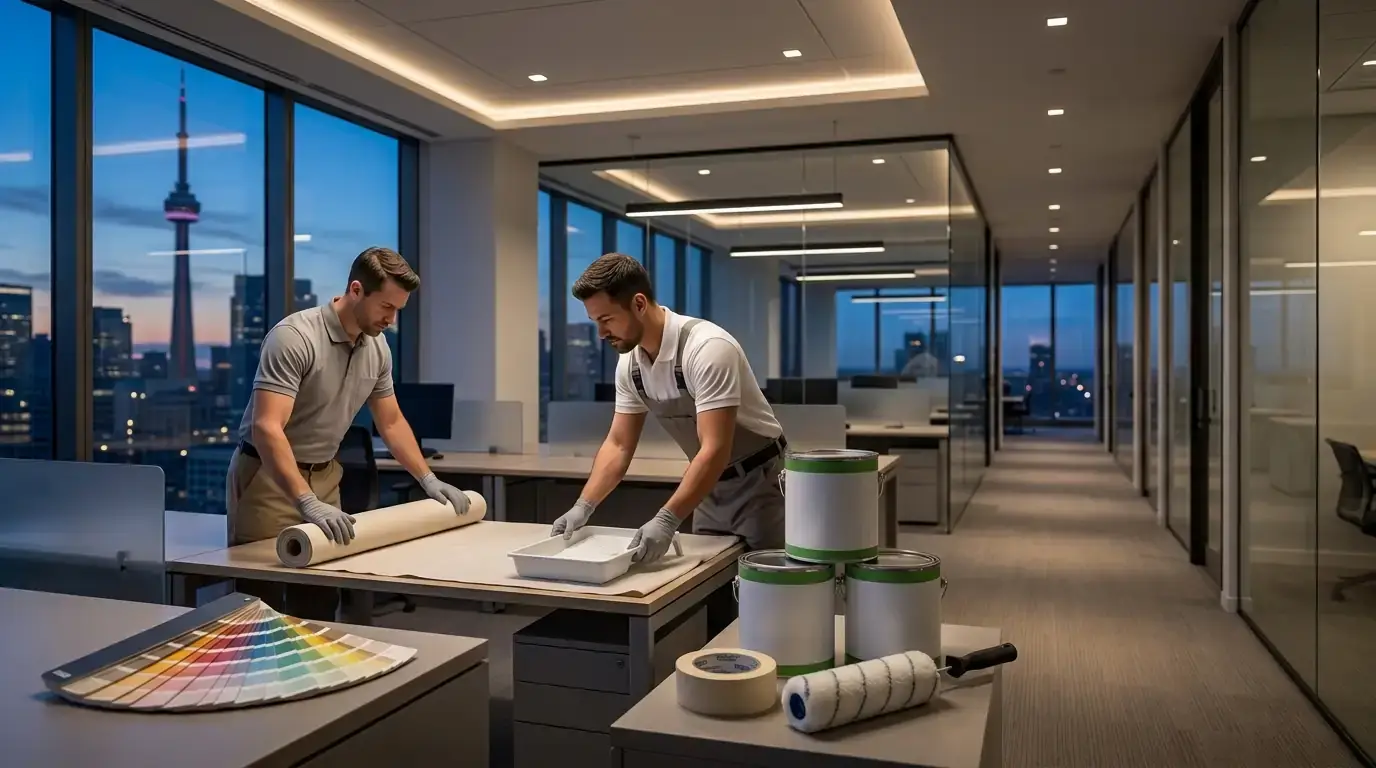
At 11:30 p.m., “dry to touch” can sound temptingly close to “ready for breakfast service.” They are not the same thing. Good restaurant painting scheduling Toronto must account for food protection, access, ventilation, surface preparation, coating instructions, cleanup, and how every square metre of that space will actually be used in a matter of hours.
That means planning the restaurant as a collection of work zones rather than one big room. A dining area, bar, washroom, corridor, service station, and commercial kitchen see different traffic, moisture, cleaning, grease, and contact. The paint choice comes after those operating realities are mapped out, not before.
Start With Closing Time and Work Backward
Write down the restaurant’s real rhythm before anyone writes a coating schedule: closing time, staff cleanup, deliveries, prep crew arrival, breakfast or lunch opening, private events, alarm procedures, elevator access, and building HVAC rules. The empty-looking window between close and reopen can shrink quickly once the nightly reset is included.
For a related next step, read Painting Cost Guide Toronto, painting cost Toronto.
For many businesses, that means working in phases rather than treating the whole restaurant as one painting zone. A dining area might be completed separately from a bar, hallway, washroom, office, or back-of-house area. Phasing can reduce disruption, but it only works when enough time is left for preparation, coating application, drying, cleanup, inspection, and safe return of furniture and equipment.
Do not schedule reopening based only on the words “dry to touch.” Manufacturers often publish different intervals for dry time, recoat time, and return to service. For example, Benjamin Moore currently lists its low-VOC Scuff-X Matte as dry in one hour, recoatable in two to three hours, and with a much longer return-to-service period. Those numbers are product-specific and can change by coating, sheen, temperature, humidity, ventilation, colour, and application conditions. Always follow the current technical data for the exact product being used.
This distinction is especially important in hospitality spaces. A wall may feel dry before it is ready for repeated washing, chair contact, carts, staff traffic, or heavy cleaning. The schedule should therefore work backward from the actual use of the area, not simply from the final brush or roller pass.
Food Protection Is Part of the Painting Plan
Painting in a food premise is not only a decorating project. Ontario Regulation 493/17 requires food premises to be maintained so that food is protected from contamination, and it requires walls and ceilings in relevant rooms and passageways to be readily cleanable and maintained in a sanitary condition. Floors, walls, and ceilings in rooms where food is handled must also be kept clean and in good repair.
Toronto Public Health also tells food businesses planning construction or renovation to review structural requirements and, when applicable, submit plans before work begins. If a painting project is part of a larger renovation, changes surfaces in food preparation areas, or creates uncertainty about compliance, the operator should contact Toronto Public Health or the local public health inspector before the work starts.
Official guidance is available from the City of Toronto structural requirements for food businesses and Ontario Regulation 493/17.
For the painting plan itself, food, utensils, food-contact items, open ingredients, small appliances, and movable preparation equipment should be removed from the active work zone or protected in a way that prevents contamination. Dust-producing preparation should be separated from food activity. The work area also needs a clear cleanup plan before restaurant operations resume.
Low VOC Helps. The Clock Still Matters.
Odour is one of the biggest concerns for an operating restaurant because guests experience the room immediately. Current manufacturers do offer commercial interior coatings with low or zero VOC claims. Benjamin Moore’s Canadian Scuff-X line is currently described as low VOC and intended for high-traffic commercial environments. Sherwin-Williams also currently lists ProMar 200 Zero VOC Interior Latex as a professional interior coating with zero VOC claims.
These products show that lower-VOC options are available, but product selection should not be reduced to a single number. Odour, ventilation, dry time, recoat time, return-to-service guidance, washability, scuff resistance, sheen, substrate compatibility, and cleaning demands all matter. A low-VOC coating is not permission to paint beside active food preparation or reopen an area before the manufacturer’s instructions allow it.
For current specifications, see the manufacturer’s information for Benjamin Moore Scuff-X or the exact coating selected for the project. The final product should be chosen for the actual surface and use area rather than because it appears on a generic restaurant-painting list.
A Dining Room Wall and a Kitchen Wall Have Different Jobs
A restaurant has more surface conditions than a typical empty office. Before choosing a finish, inspect what is actually on the wall or ceiling.
- Dining-room walls: Look for chair marks, hand contact, food splashes, old patching, picture holes, and areas polished by repeated wiping.
- Bars and service counters: Expect concentrated traffic, bumps, moisture, cleaning, and contact around corners and narrow passages.
- Washrooms: Check humidity exposure, peeling edges, failed caulking, stains, and surfaces that receive frequent cleaning.
- Commercial kitchens and prep areas: Grease, moisture, heat, prior coating condition, cleaning chemicals, and sanitation requirements make preparation and product selection more demanding.
- Doors, frames, trim, and railings: These high-touch areas often need different preparation and a more durable coating than broad wall areas.
- Ceilings: Inspect for staining, moisture history, ventilation issues, grease residue, and repairs before coating.
If grease, smoke residue, soap film, or other contamination remains on the surface, new paint can fail regardless of how expensive the coating is. Cleaning and surface preparation must come before finish selection. Any active leak, condensation problem, damaged drywall, failed caulking, or loose coating should also be addressed before repainting.
What an After-Hours Shift Actually Has to Fit In
A good hospitality painting plan is easier to manage when every shift has a defined stopping point. The exact sequence changes by property, but a typical planning framework looks like this:
- Confirm the work zone. Decide exactly which walls, ceilings, doors, trim, or service areas are included that shift.
- Protect food and operations. Remove or isolate food, utensils, portable equipment, furniture, decor, electronics, and anything that should not be exposed to dust or coating materials.
- Clean the surfaces. Remove grease, soil, dust, fingerprints, and residues using a method compatible with the substrate and coating system.
- Complete repairs. Patch dents, holes, cracks, damaged drywall, failing caulking, and other defects. Larger repairs may need their own drying period.
- Sand only where appropriate. Control dust and fully clean the area afterward. Preparation should not spread debris into active food or service zones.
- Prime where required. Bare repairs, stains, difficult substrates, adhesion concerns, or major colour changes may require a primer selected for that condition.
- Apply the finish coats. Follow the manufacturer’s application temperature, ventilation, spread rate, dry-time, and recoat instructions.
- Inspect before teardown. Check coverage, edges, repaired areas, sheen consistency, missed spots, drips, and damage while lighting and access are still available.
- Clean and reset the zone. Remove masking, dust, debris, tools, and coverings. Return furnishings only when doing so will not damage the coating.
- Respect return-to-service guidance. Do not confuse a coating that can accept another coat with one that is ready for washing, repeated contact, or heavy use.
Ventilation Cannot Be an Afterthought at 2 a.m.
Ontario’s Food Premises Regulation requires the ventilation system in a food premise to be maintained to eliminate odours, fumes, vapours, smoke, and excessive heat. For painting, the practical lesson is to discuss ventilation before work begins rather than assuming doors can simply be opened after application.
Restaurant ventilation systems can be complicated. Kitchen exhaust, make-up air, dining-room HVAC, neighbouring tenants, security requirements, exterior doors, and overnight building controls can all affect air movement. The painting contractor and operator should understand which systems can run, who controls them, and whether building management has rules for after-hours ventilation.
Ventilation also affects drying. Temperature and humidity can change how a coating behaves, so the product’s current technical instructions should remain the reference point.
The Kitchen Is Where Generic Paint Advice Falls Apart
Commercial kitchen painting should not be treated as ordinary dining-room painting. Before work starts, identify whether the surface is actually suitable for architectural paint and whether it is part of a wall, ceiling, equipment system, food-contact surface, hood assembly, or another component with separate requirements.
Do not assume every shiny or washable coating is automatically appropriate for every kitchen surface. Walls and ceilings need to remain cleanable and sanitary, but the correct system depends on the substrate, existing coating, moisture, grease exposure, cleaning routine, and the manufacturer’s stated use.
When the kitchen remains operational during a phased project, the safest planning approach is to keep preparation and painting out of active food-handling zones. If that cannot be done cleanly, the operator should reconsider the work window rather than trying to force painting into normal preparation or service hours.
Where Overnight Schedules Usually Unravel
Most overnight painting problems are not dramatic. They are ordinary details discovered too late, which is exactly why they are expensive and annoying.
- Choosing the colour before assessing the walls. Repairs, stains, grease, moisture, and coating condition can change the required system.
- Assuming low VOC means no odour. Check the exact manufacturer’s claims and plan ventilation and occupancy accordingly.
- Using recoat time as reopening time. These are not the same thing.
- Painting every area with the same sheen. Traffic, cleaning, appearance, glare, and substrate conditions differ by zone.
- Leaving furniture movement until the first work night. Access can consume a large part of a short after-hours window.
- Skipping cleaning in grease-prone areas. Coating over contamination can undermine adhesion and appearance.
- Ignoring morning reset time. The plan needs enough time for inspection, cleanup, waste removal, ventilation, and replacement of furnishings.
- Trusting generic “food-safe paint” claims. Verify the actual product, intended substrate, technical data, and the regulatory needs of the space.
The Morning Walkthrough Matters More Than the Midnight One
The final walkthrough should happen before staff begin resetting the entire space. Check that the work area is clean, surfaces are free of visible dust and debris, masking has been removed, fixtures are usable, exits and paths are clear, and no tools or coating materials remain where they could interfere with operations.
Also inspect the finish under the restaurant’s normal lighting. Decorative lighting can reveal roller lines, missed edges, poor patches, flashing, or sheen differences that were not obvious under temporary work lights.
Finally, confirm what the coating manufacturer says about normal handling, cleaning, and return to service. Staff should know if freshly painted walls need a period of gentler use before routine scrubbing or repeated contact.
Planning Questions to Resolve Before the Crew Arrives
Before approving the work plan, confirm these points:
- Which areas will be painted and in what order?
- When will food preparation stop in each affected zone?
- Who moves or protects furniture, equipment, decor, and food-related items?
- What cleaning and repairs are required before coating?
- Which primer and finish are specified for each surface?
- What are the current dry, recoat, and return-to-service instructions?
- How will ventilation operate during and after the work?
- How much time is reserved for cleanup and morning reset?
- Does building management need advance notice for access, alarms, elevators, loading, or HVAC?
- Should Toronto Public Health be consulted because the work is part of a larger food-premise renovation?
Answering these questions before the first work shift is what makes restaurant painting scheduling Toronto manageable. The planning happens before the crew arrives, not after.
Restaurant Painting Questions Answered
Can a Toronto restaurant be painted after closing and reopen the next morning?
Sometimes, but never assume it. Success depends on the scope of preparation, the exact coating and its return-to-service requirements, ventilation, temperature, humidity, cleanup time, and how the space will be used the next morning. A manufacturer’s return-to-service guidance is the only reliable timeline. Generic overnight promises are not.
Does a restaurant need zero-VOC paint?
There is no universal zero-VOC requirement for every restaurant surface. Low-VOC and zero-VOC commercial coatings are available and worth considering, but the final choice should weigh substrate compatibility, washability, durability, odour control, ventilation, finish appearance, and what the manufacturer actually says about the product’s use in food-service environments.
What paint finish is best for restaurant walls?
There is no single best sheen. Dining rooms, corridors, washrooms, kitchens, doors, and trim each have different cleaning and wear demands. Choose the finish based on traffic level, cleaning routine, surface condition, aesthetic goals, and the coating manufacturer’s specific recommendations for commercial hospitality environments.
Can painters work while the kitchen is preparing food?
Not in the same zone. Painting and dust-producing preparation must be planned to avoid contaminating food and interfering with sanitary operation. Keeping active food preparation and coating work in completely separate zones is usually the only safe approach. If the renovation creates any doubt about food-premise compliance, contact Toronto Public Health before work begins.
How should restaurant owners prepare for an after-hours painting project?
Confirm everything in writing before the crew arrives: work zones, operating schedule, furniture and equipment movement plan, food protection protocol, cleaning requirements, building access, ventilation arrangement, alarm procedures, product specifications, and morning reset responsibilities. Discovering these details on the night of the job costs time the schedule cannot afford.
A Good Paint Schedule Protects Tomorrow’s Service
The best hospitality painting plan balances finish quality with sanitation requirements, customer experience, staff access, realistic cleaning demands, and the coating’s actual performance timeline. That balance comes from starting with an operational walkthrough of the space, not with a colour chip.
For a related overview of commercial interior work, see commercial painting in Toronto.
For restaurant or hospitality work, a useful quote starts with operating hours, access, work zones, surface condition, and the reopening target, not just square footage. PaintersInToronto.ca works with one licensed and insured independent painting company, and any service agreement is directly with that contractor. Call (647) 532-9046 and Ask for SUNNY, or share the project through the contact page.