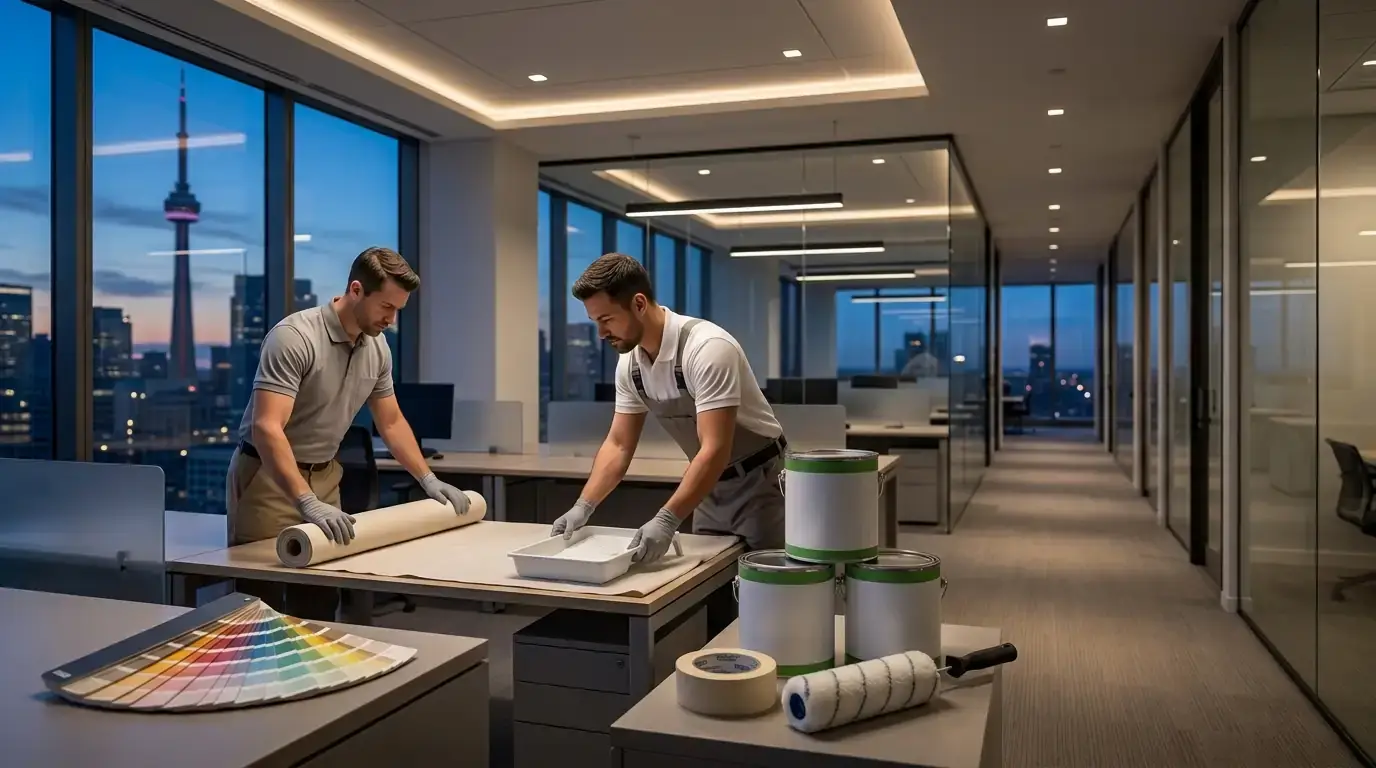
The worst time to discover that the freight elevator is booked is when a painting crew is standing in the lobby with ladders. Good office painting Toronto scheduling starts well before the first roller touches a wall. The real job is to decide which spaces can go offline, when staff and visitors leave, how the crew will move through the building, how ventilation will be handled, and what has to be true before each area is handed back.
After-hours painting is often useful, but it is not automatically the answer for every square foot. A vacant boardroom may be painted in the daytime. A reception area may belong on an evening shift. A busy corridor might need a weekend window. Health Canada’s current indoor-air guidance supports low-emission product selection, adequate ventilation and administrative controls during renovation work, and notes that evenings or weekends may be preferable for some chemical-product activities when regular occupants are absent.
Build the Schedule From Occupancy, Not From Wall Area
Start with a floor plan and then walk the office while it is operating. The drawing shows rooms. The walkthrough shows where the actual headaches live.
For a related next step, read Painting Cost Guide Toronto, painting cost Toronto.
Mark:
- reception and visitor routes
- open work areas
- private offices
- boardrooms and meeting rooms
- corridors and stair access
- kitchens and lunchrooms
- server, telecom or IT rooms
- copy and storage rooms
- elevators and loading access
- emergency routes that must remain clear
- shared spaces used by other tenants
Then give every zone an operating priority. Which rooms must be usable at 8 a.m.? Which can stay closed until noon? Which are vacant on Fridays? A handback deadline is much more useful than one giant completion date for the whole office.
Decide What Belongs on the Night Shift
Office painting Toronto after hours makes sense when preparation noise, ladders, protection or paint activity would interfere with normal operations. Current Toronto commercial-painting companies commonly offer evenings, overnight work, weekends and phased scheduling for occupied offices.
After-hours work is particularly useful for reception, busy corridors, open work areas and rooms that cannot be surrendered during normal hours. Daytime painting can still work in vacant suites, unoccupied meeting rooms or isolated sections where the business can create a clean boundary around the crew.
The schedule can be mixed. There is no prize for painting every room at midnight if half the office is empty at 2 p.m. A mixed schedule can also reduce fatigue and leave more room for proper inspection instead of turning the project into a race against sunrise.
Building Management Can Control the Calendar
In a multi-tenant Toronto office building, contractor logistics can be as important as the coating. Confirm the property-management requirements before the painting dates are promised internally.
Ask about:
- contractor sign-in and security procedures
- approved work hours
- service or freight elevator bookings
- loading-dock access
- parking
- common-area protection
- where tools and paint may be staged
- waste removal
- alarm or access-card procedures
- HVAC or ventilation coordination
- any notice required for neighbouring tenants
A building that operates around the clock can still have very specific contractor rules. “The doors are open” and “the painters are approved to work” are not the same sentence.
Low Odour Helps. Ventilation Still Has a Job.
Health Canada’s current guidance for indoor-air-quality professionals recommends choosing low-emission products where possible, ensuring adequate ventilation during renovation work involving products such as paint, and using administrative controls to minimize occupant exposure. It also notes that susceptible occupants should receive sufficient notice and may need to be outside the building during renovation activities involving chemical products.
That means a low odour office painting Toronto plan still needs to address air movement, work-zone isolation, staff communication and the exact product instructions. Zero-VOC is useful information. It is not an invisibility cloak for the painting process.
For current guidance, see Health Canada’s indoor air quality guidance.
Specify the Coating by Office Zone
One coating across the entire floor can simplify ordering, but it may not be the best maintenance decision. Private offices, corridors and doors live different lives.
| Office area | Main concern | Useful coating characteristic |
|---|---|---|
| Private offices | Appearance, touch-up, lower disruption | Low-odour interior coating with suitable sheen |
| Open work areas | Occupant exposure and schedule | Low-emission system with planned ventilation |
| Corridors and lobbies | Scuffs and frequent cleaning | Commercial scuff-resistant washable coating |
| Meeting rooms | Fast operational handback | Quick-drying commercial interior coating matched to use |
| Doors and frames | Hands, impacts and cleaning | Durable trim or enamel system |
| Lunchrooms | Wiping and splash exposure | Washable coating appropriate to the substrate |
Current Product Examples Show Why One Specification Is Not Enough
Low-emission occupied-space option
Benjamin Moore Canada currently describes Eco Spec as zero VOC and zero emissions even after tinting, with very low odour, and identifies offices among the environments where it can be considered. This is the kind of product path worth evaluating when the lowest practical emission and odour profile is a priority.
High-traffic commercial option
Benjamin Moore Canada currently lists Scuff-X as a low-VOC commercial interior coating for high-traffic areas including offices, conference rooms, hallways and lobbies. Its current matte data lists approximately one hour dry time and 2 to 3 hours recoat time under stated conditions.
Professional zero-VOC option
Sherwin-Williams currently lists ProMar 200 Zero VOC Interior Latex for professional interior walls, ceilings and trim. It provides another current product category to evaluate where the project specification calls for zero-VOC interior coating.
These are examples, not universal recommendations. Surface condition, sheen, cleaning, traffic, colour, primer and current technical data still control the final system.
Preparation Is Often the Part That Wrecks a Tight Schedule
Managers often budget time for “painting” and forget the work that happens before the finish coat. The disruption can include furniture protection, anchor removal, patching, sanding, spot priming, masking and dust control.
Build an office interior painting schedule that accounts for:
- protecting floors, desks and glass
- removing wall-mounted items where authorized
- patching anchor holes and drywall damage
- sanding and dust removal
- cleaning high-touch walls
- spot priming
- finish coating
- recoat windows
- touch-ups
- cleanup and inspection
A corridor with forty anchor holes can spend more time in preparation than in actual rolling. If staff need that corridor at 7:30 a.m., the schedule must respect the prep, not just the paint-can dry time.
IT Equipment Needs an Owner, Not a Guess
Computers, docking stations, monitors, printers, cameras, access-control devices and server equipment need a plan before the crew arrives. Painters should not be deciding which cable can be unplugged or whether a rack can be moved.
Have the office or IT team identify equipment that cannot move, equipment that can be shut down, and who is authorized to disconnect it. Protect electronics from dust and spatter without blocking ventilation openings. Keep detectors, sprinklers, cameras and sensors unobstructed.
Desks are furniture, not scaffolding. It sounds obvious until 11:15 p.m. on a tight shift.
Use Handback Zones Instead of One Big Finish Date
Each phase should have a defined release point:
- Release the area. Staff remove personal items and confirm the zone is ready.
- Protect and prepare. Floors, furniture, glass and equipment are covered; repairs are completed.
- Prime where needed. Repairs and problem substrates get the specified primer.
- Apply the finish system. The crew follows current temperature, ventilation and recoat guidance.
- Inspect. Coverage, edges, repairs and touch-ups are checked under normal lighting.
- Clean and clear. Tools, waste and temporary protection are removed when appropriate.
- Hand back. The office confirms the area is ready for its intended level of use.
This makes progress visible and prevents a nearly finished project from blocking the entire office because one zone is still under repair.
Dry, Recoatable and Ready for Office Life Are Different Milestones
A coating can be dry to the touch before it is ready for furniture contact, aggressive cleaning or repeated impact. The Scuff-X example above separates dry and recoat times, and manufacturer data for many coatings includes longer service or cure considerations.
Before staff return, confirm what level of use the zone is expected to handle. Do not press filing cabinets against a fresh wall simply because the roller left six hours ago.
The Morning Handback Check
Before employees come back, verify that:
- the planned coats and repairs are complete
- touch-ups have been inspected
- floors and desk surfaces are clean
- ladders, tools and waste are gone
- normal and emergency travel routes are clear
- doors, access hardware and switches operate normally
- ventilation is restored to the agreed condition
- staff communication has been completed
- furniture is not rubbing against fresh coating
- the product has reached the stage required for the intended use
A Sample Phasing Logic for a Working Office
Imagine a medium-sized office with reception, two open work areas, four meeting rooms and one main corridor. Painting everything in one overnight push sounds efficient until preparation reveals damaged drywall and the crew loses an hour waiting for elevator access.
A more resilient plan might release meeting rooms first because they can be taken out of service individually. Reception follows on an evening when visitor traffic ends early. Open work areas are split into two zones so one half remains functional while the other is protected and painted. The main corridor is saved for a weekend window because ladders and prep would otherwise interfere with everyone.
The point is not that every office should follow that exact sequence. It is that phasing should reflect the consequences of a delay. If a meeting room takes an extra morning, the business still functions. If the only corridor is unfinished at 8 a.m., the whole floor notices.
Communicate the Plan to Staff Before the Smell Becomes the Announcement
Employees should know which areas are closing, what belongings to remove, whether desks need to be cleared and when each zone is expected back in service. Health Canada’s guidance specifically supports administrative controls and advance notice for susceptible occupants during renovation activities.
A short internal notice can cover the work dates, affected rooms, alternate meeting spaces, ventilation plan, who to contact with concerns and any restrictions on touching or cleaning fresh surfaces. That is more useful than letting the first clue be a hallway full of drop cloths on Monday morning.
Office Painting Questions That Affect the Schedule
Can a Toronto office be painted after hours?
Yes. Evening, overnight and weekend painting are common current commercial scheduling options, subject to building access, staffing, preparation and coating requirements.
Is night work always better?
No. Vacant or isolated areas may be more efficient during the day. The best plan uses the least disruptive window for each zone.
Does zero-VOC paint eliminate the need for ventilation?
No. Health Canada still recommends ventilation and exposure controls during renovation activities involving paints and other chemical products.
How soon can employees return?
There is no universal time. Product data, ventilation, temperature, humidity, odour, work-zone condition and intended use all matter.
Who should move computers?
The tenant or authorized IT team should decide what can be disconnected or relocated. Painters can protect equipment, but they should not make unauthorized IT decisions.
What should building management know?
Confirm access hours, elevators, loading, security, common-area protection, staging, waste procedures and any ventilation coordination before the crew arrives.
How should a large office be phased?
Use operational handback zones based on departments, traffic routes and business needs, and finish one zone through inspection and cleanup before releasing it.
Schedule the Reopening, Not Just the Painting
The strongest office painting Toronto scheduling plan works backward from normal business use. Map occupancy, coordinate the building, choose coatings by zone, give preparation enough time, protect IT equipment and define exactly what “ready for staff” means. The paint colour is visible. The scheduling work is what keeps everyone from talking about the project for the wrong reasons.
For broader commercial planning, see commercial painting in Toronto.
For an office painting review, Request a Free Quote through PaintersInToronto.ca. The website works exclusively with one licensed and insured independent painting company, and any service agreement is directly with that contractor. Call (647) 532-9046 and Ask for SUNNY, or use the contact page.

