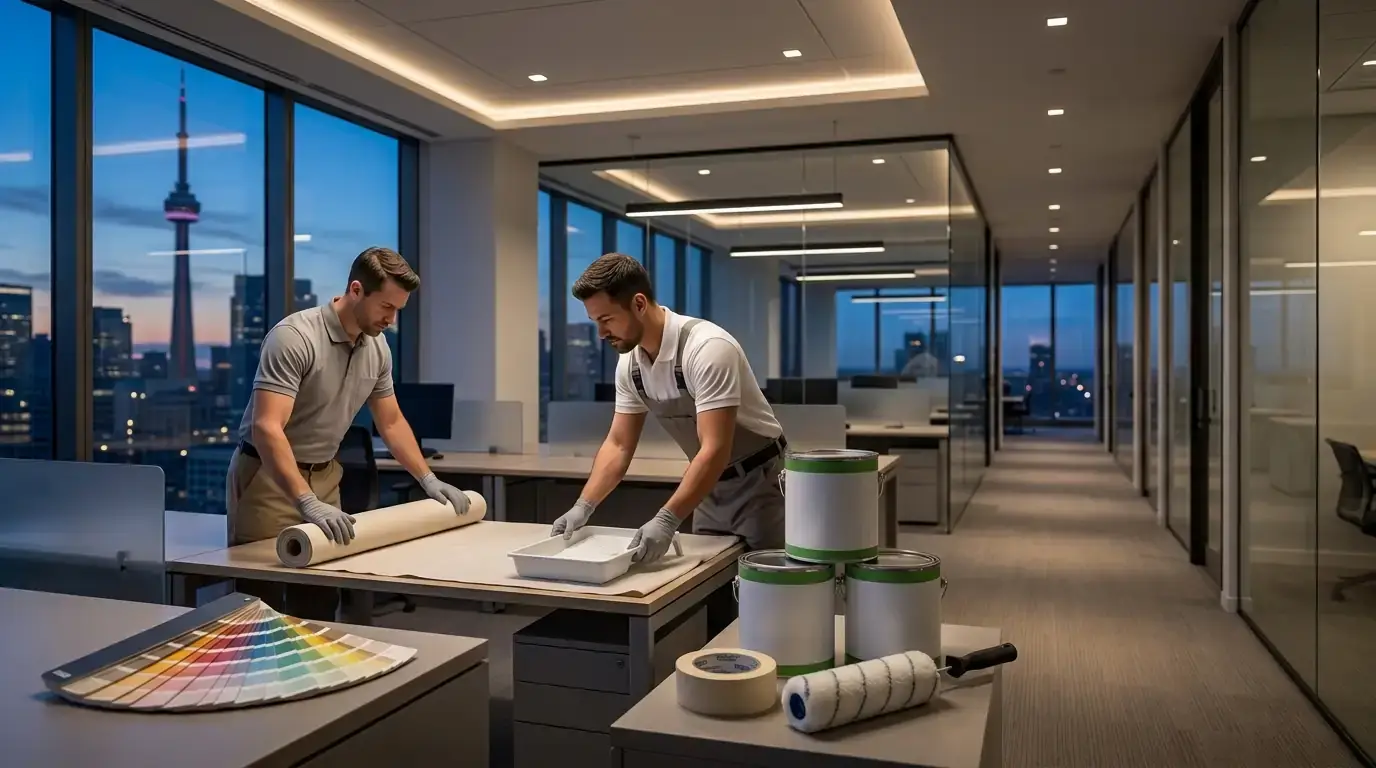
Commercial painting without closing business operations is usually planned through after-hours shifts, weekend work, or controlled zones that reopen after inspection. Start by mapping customer routes, employee work areas, entrances, washrooms, fire exits, ventilation zones, sensitive equipment, security requirements, and the maximum time each area can be unavailable.
The goal is not to pretend painting causes no disruption. The goal is to place preparation, repairs, coating, drying, ventilation, cleanup, and reopening into predictable windows. Some areas may stay open while others close temporarily. No area should reopen only because the wall feels dry.
Commercial Painting Without Closing Business Starts With an Impact Map
Before requesting final pricing or dates, create a floor plan that identifies how the business operates. Mark:
- Main customer and employee entrances
- Reception, sales, service, and checkout areas
- Emergency exits and fire routes
- Washrooms, lunchrooms, and shared corridors
- Workstations, displays, inventory, and sensitive equipment
- High-noise or dust-sensitive areas
- HVAC zones, returns, and outdoor air locations
- Alarm, key, fob, elevator, loading, and security procedures
- Peak business hours and low-traffic periods
- Areas that can be moved, closed, or completed in phases
Give the same information to every contractor. A quote based on empty-space assumptions cannot be compared fairly with one that includes nightly protection, furniture movement, building access, security sign-out, and morning handback.
Choose the Scheduling Method by Business Type
| Commercial setting | Useful scheduling approach | Main planning concern |
|---|---|---|
| Office | Evening zones, floor-by-floor work, weekend common areas | Workstations, data security, meetings, ventilation, morning reopening |
| Retail store | After closing, department phases, closed fitting-room or stock zones | Customer routes, merchandise protection, displays, dust, checkout access |
| Medical or dental office | Weekend or carefully isolated room phases | Clinical operations, product approval, ventilation, cleaning, sensitive occupants |
| Restaurant or cafe | Closed-day work, overnight front-of-house phases, planned kitchen separation | Food areas, grease removal, sanitation, curing, odour, opening inspection |
| Fitness or recreation facility | Section closures, overnight work, low-use-day scheduling | Member routes, equipment movement, humidity, cleaning, high-contact surfaces |
| Multi-tenant building | Floor, corridor, stairwell, or lobby phases | Tenant notices, elevators, exits, security, shared HVAC, quiet hours |
| Warehouse or light industrial space | Aisle or production-zone phases, shutdown windows | Forklifts, dust, lifts, inventory, traffic control, industrial coatings |
The business type does not determine the full plan. A quiet office with remote staff may allow daytime work, while a small clinic may need complete isolation and weekend curing. The contractor, business operator, property manager, and building systems contact should agree on the schedule.
Separate Preparation From Finish Painting
Preparation often creates more disruption than applying the finish coat. Sanding, scraping, drilling, drywall repair, caulking removal, lift movement, vacuuming, and furniture relocation can create noise, dust, blocked routes, and equipment hazards.
Build separate time windows for:
- Protection and relocation: Cover or move furniture, displays, electronics, stock, and floor areas.
- Repairs: Patch drywall, repair trim, address failed coatings, and allow materials to dry.
- Dust-producing preparation: Sand, scrape, vacuum, and clean before occupants return.
- Priming: Apply the correct primer to repaired, bare, stained, or incompatible areas.
- Finish painting: Complete planned coats and detailed cutting.
- Cure and ventilation: Follow product-specific instructions before reopening.
- Cleaning and handback: Remove waste and protection, restore the zone, and inspect it.
A quiet rolling shift may be acceptable near limited operations when the work zone is separated. Mechanical sanding beside customers, patients, food service, or exposed merchandise usually needs a more restrictive plan.
Use Low-Odour Products Carefully
Current Canadian product lines include low-odour and zero-VOC options. Benjamin Moore Canada describes Eco Spec Interior as low odour, zero VOC, and zero emissions, with rapid return-to-service benefits. Ultra Spec 500 is also currently described as a professional-quality zero-VOC interior coating.
These examples show that occupied-space options exist. They do not prove that every primer, patching compound, cleaner, caulk, stain blocker, or specialty coating has the same properties. They also do not replace ventilation or the safety instructions for the selected system.
The Canadian Centre for Occupational Health and Safety recommends good ventilation during painting. Its indoor air quality guidance explains that temporary ventilation increases can help dilute fumes and that reducing recirculated air may be advisable during contaminant-producing activities.
Coordinate with the building operator before changing HVAC settings. Confirm:
- Which air handlers serve the work zone
- Whether returns need temporary protection or adjustment
- How outdoor air and exhaust will operate during and after the shift
- Whether odour could migrate to another tenant or occupied floor
- Who approves normal HVAC operation after cleanup
- Whether sensitive occupants require a different schedule or product
Use current product data sheets and safety data sheets for the exact materials. Do not rely only on a general label such as low odour.
Plan Customer, Employee, and Emergency Routes
A business can remain open only when people can move safely without entering the work zone. Ladders, tools, wet coatings, extension cords, plastic barriers, lifts, and covered floors must not interfere with exits or create an improvised public pathway.
The phase plan should show:
- Open and closed entrances
- Temporary customer routes
- Accessible routes and washrooms
- Emergency exits kept available
- Contractor material and waste routes
- Areas where signs or staff direction are required
- Where barriers begin and end
- Who may enter the work zone
Do not use vague instructions such as “work around customers.” Define the exact boundary and the times it changes.
Coordinate Building Access and Security
After-hours work often depends on building management. Confirm access before the project date, including:
- Contractor insurance documents
- Security registration and worker identification
- Keys, fobs, alarm codes, and sign-in procedures
- Service elevator and loading-dock reservations
- Parking and vehicle restrictions
- Noise and contractor-hour rules
- Waste removal and storage limits
- HVAC operating requests
- Emergency contact procedures
- Who locks, alarms, and signs off at the end of each shift
For offices, also decide how confidential records, computer equipment, server areas, employee belongings, and restricted rooms will be handled. Painters should not be expected to move sensitive material without written direction.
Create a Nightly Handback Standard
When the business reopens each morning, every completed or paused zone should meet a written handback standard.
Before the contractor leaves, confirm:
- Wet paint is isolated from customers and employees
- Required drying and ventilation time has been met or remains controlled
- Tools, ladders, cords, and open materials are removed or secured
- Floors, desks, counters, displays, and fixtures are clean
- Furniture and equipment are returned to the agreed positions
- Fire exits, corridors, doors, and washrooms are usable
- Waste is removed according to the building procedure
- HVAC and alarms are returned to the approved settings
- The next shift boundary is marked and communicated
- A business representative has accepted the zone for reopening
A daily photo record can document progress, protection, and the condition at handback. It also helps the next shift begin without repeating decisions.
Build a Realistic Phase Schedule
Divide the project into zones small enough to complete, clean, and return within the available window. A zone that is too large may leave unfinished cut lines, wet doors, exposed repairs, or furniture without a safe location.
For each phase, record:
- Zone name and boundaries
- Protection and setup time
- Repair and preparation time
- Primer and finish-coat windows
- Product dry and recoat requirements
- Ventilation period
- Cleanup and restoration time
- Inspection and reopening time
- Backup plan if repairs take longer than expected
Doors, washrooms, reception desks, stairwells, elevators, and shared corridors often need their own phases because they cannot be closed casually.
How After-Hours Scheduling Affects the Quote
After-hours work may cost more, but there is no verified universal Toronto premium. One current Toronto contractor publishes a 10 to 15 percent premium, while other providers describe after-hours work without publishing a percentage. Treat any figure as contractor-specific.
Price can change because of:
- Evening, overnight, weekend, or overtime labour
- Short work windows with repeated setup and cleanup
- Multiple mobilizations and phase boundaries
- Security, concierge, elevator, parking, or building fees
- Daily furniture movement and protection
- Special ventilation or isolation
- Fast-drying or specialized coatings
- Restricted delivery and waste-removal times
Ask for regular-hours and after-hours options when both are realistic. Compare the total business impact, not only the painting invoice. Any price or premium is an estimate only. The actual price may be lower or higher after the property, surfaces, preparation, access, materials, timing, size, and scope are reviewed.
Common Scheduling Mistakes
- Promising zero disruption before the site is assessed
- Scheduling by square footage without studying operations
- Choosing low-odour paint but ignoring cleaners, primers, repairs, and ventilation
- Leaving furniture movement until the first shift
- Forgetting elevator, security, parking, and alarm procedures
- Painting customer routes without a temporary traffic plan
- Allowing the next shift to begin without a documented handback
- Opening before the exact coating system is ready for service
For service information related to offices, retail spaces, facilities, and other active properties, review the commercial painting page.
Frequently Asked Questions
Can commercial painting be completed while a business stays open?
Often, yes, through after-hours work, weekends, or controlled phases. Some preparation, coating, or curing stages may still require temporary closure of a room or zone. The site assessment should determine what can remain operational safely.
Does zero-VOC paint mean employees can stay beside the work area?
No. Zero-VOC and low-odour products can reduce certain concerns, but the complete product system, ventilation, separation, preparation dust, sensitive occupants, and safety instructions still matter. Occupancy decisions should follow the approved work plan.
How are desks and merchandise protected during commercial painting?
The scope should identify what the business moves, what the contractor moves, what remains covered, and what must be removed from the zone. Electronics, confidential documents, food, medical items, fragile displays, and high-value inventory need specific instructions.
Do commercial painters charge more for nights and weekends?
They may. Pricing varies with labour schedules, shift length, repeated setup, building access, security, ventilation, and phase complexity. There is no universal Toronto percentage, so request a written line item or alternate schedule.
What should be checked before reopening a painted area?
Confirm the product-specific return-to-service requirements, ventilation, clean surfaces, safe routes, removed tools, secured wet areas, working exits, restored furniture, HVAC settings, and approval from the designated business representative.
Request a Commercial Painting Schedule
PaintersInToronto.ca works exclusively with one licensed and insured independent painting company. Any service agreement is directly with that independent contractor. To discuss commercial painting without closing business operations, Request a Free Quote, call (647) 532-9046, and Ask for SUNNY.