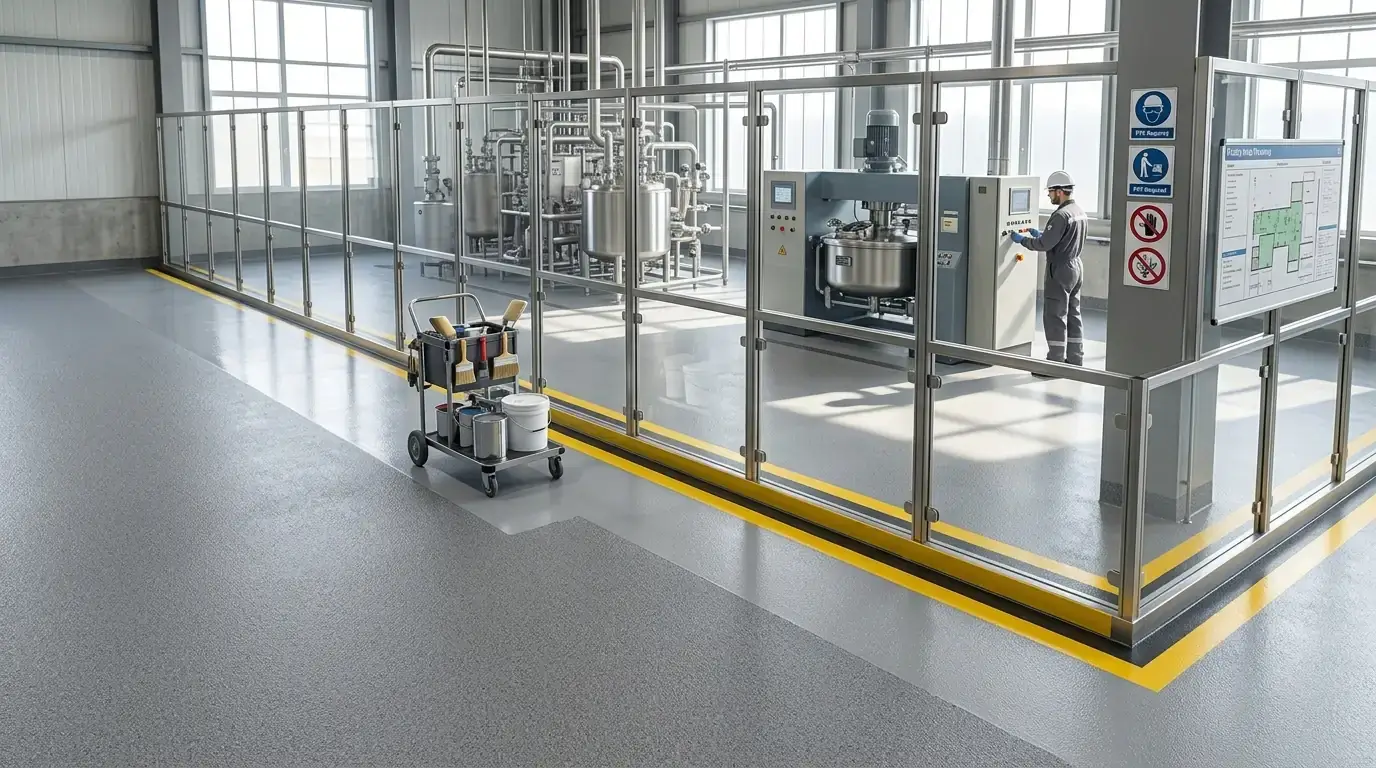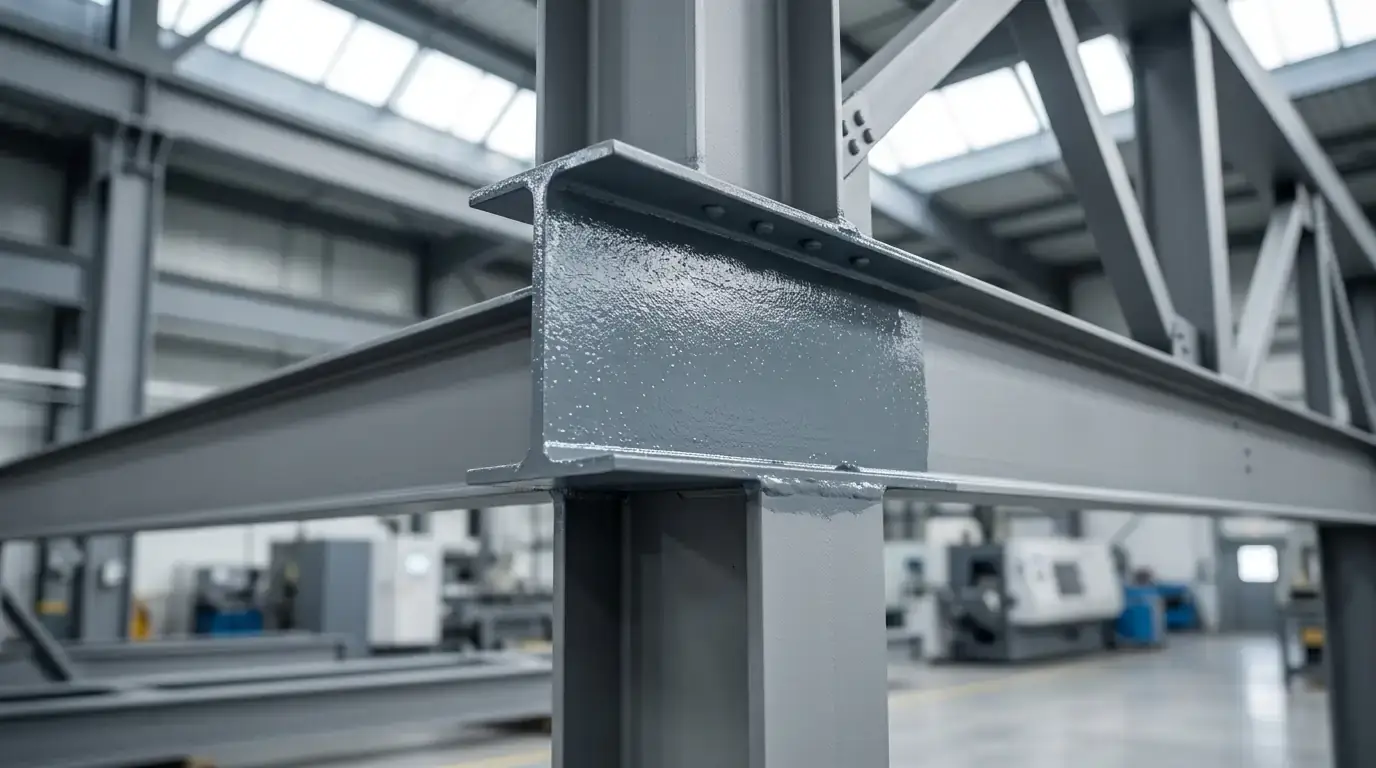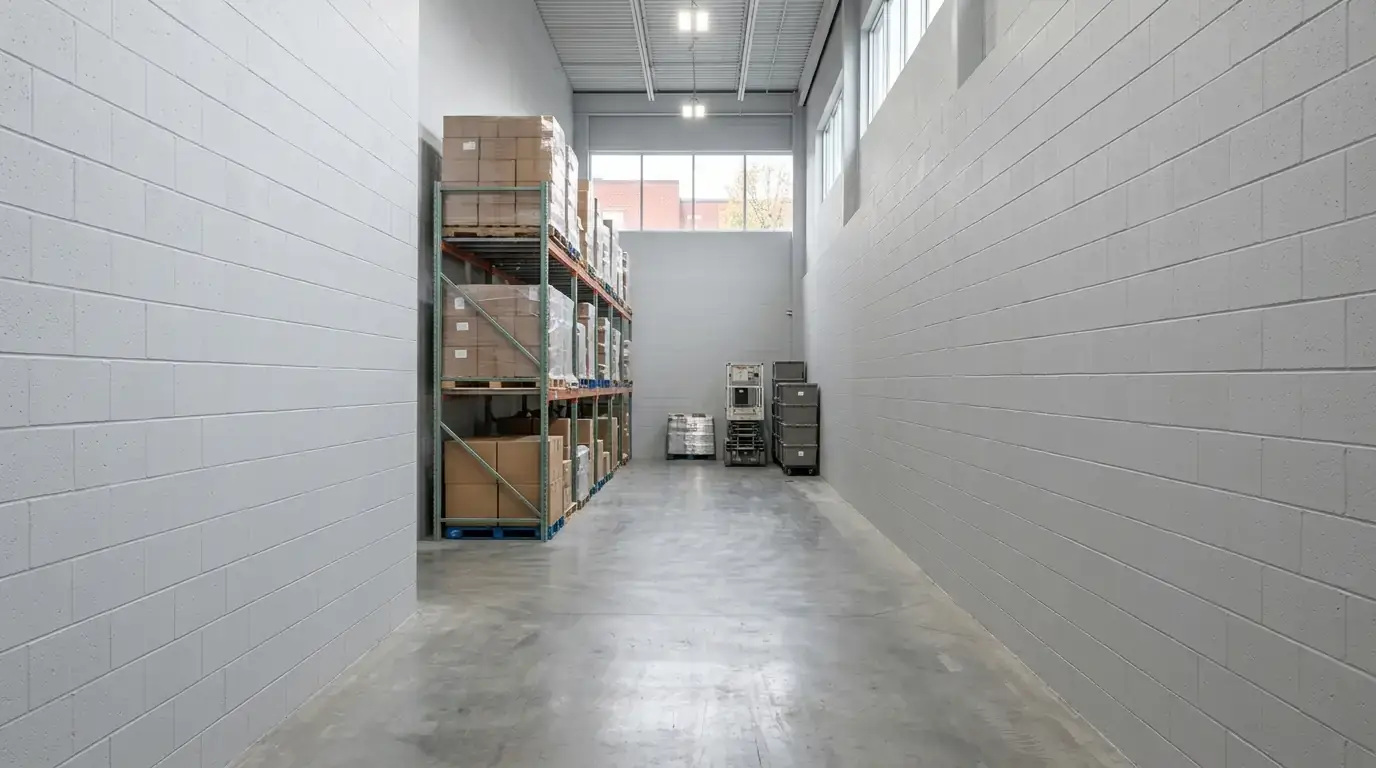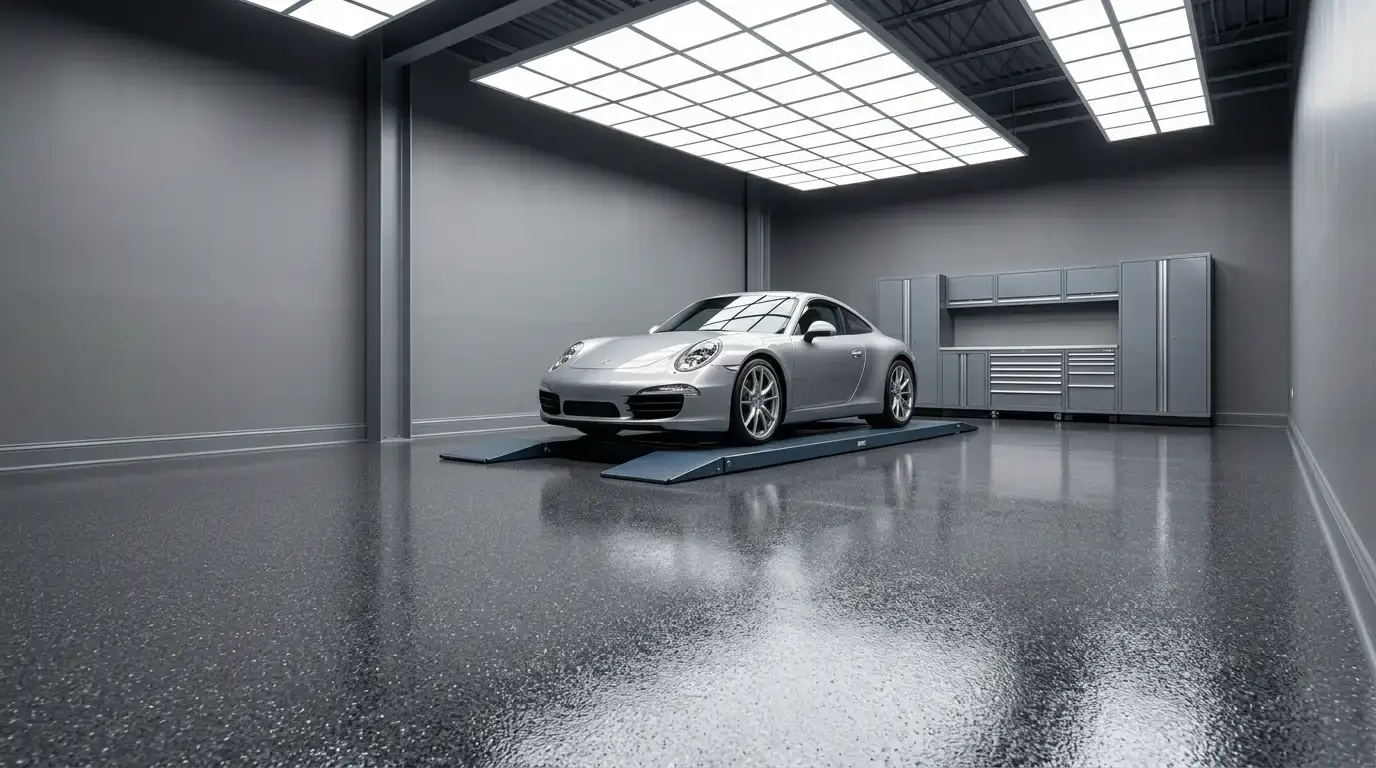
An auto service bay painting floor coating project has a rough job description. The floor has to survive tires, dropped tools, oil, coolant, cleaners, rolling equipment, and the occasional mystery spill, while the walls get fingerprints, splashes, scuffs, and repeated washing. Choosing a glossy resin and a washable wall colour before mapping those exposures is backwards. Start with how each bay is used, what the concrete has absorbed over the years, which fluids are present, how the shop cleans, and exactly when vehicles need to return.
Current Sherwin-Williams automotive-facility guidance treats service-bay flooring as a high-demand system exposed to compressive loads, impact, abrasion, petroleum products, solvents, chemical spills, and frequent cleaning. In other words, this is not a garage-paint problem with better lighting. The floor needs a resinous system matched to the bay, while hard-use wall areas need a finish selected for cleaning and contact rather than colour alone.
Map the Bay Before You Pick the Resin
Walk the shop before choosing products. Divide the building into zones with different demands.
For a related next step, read Epoxy Flooring Toronto.
- Vehicle service bays: tire traffic, lifts, jack stands, dropped tools, oils, cleaners, and repeated rolling loads.
- Wash or detailing bays: water, cleaners, drainage, slip risk, and more frequent washing.
- Battery or fluid-service areas: potentially more aggressive chemical exposure that should be checked against exact manufacturer resistance data.
- Alignment and tire areas: concentrated equipment loads, wheel movement, and abrasion.
- Parts and storage rooms: lighter traffic but possible oil and chemical storage.
- Customer-facing service reception: appearance and cleanability may matter more than heavy chemical resistance.
- Walls around active work zones: hand contact, tool marks, dirt, oils, cleaners, and repeated washing.
The goal is not to force one floor or wall coating through every room. The goal is to use one coordinated colour and maintenance plan while matching the coating system to each exposure.
The Chemical List Belongs Beside the Colour Chart
A specification that says only “chemical-resistant epoxy” is not finished yet. List the actual chemicals first.
An auto shop may use or encounter:
- engine oil
- transmission fluid
- coolant and antifreeze
- hydraulic fluid
- brake-related fluids and cleaners
- degreasers
- fuel
- wheel and tire cleaners
- battery-service chemicals
- floor-cleaning products
Current Sherwin-Williams automotive-flooring guidance confirms that petroleum products, solvents, chemicals, heavy traffic, impact, and cleaning are normal design concerns in service bays. Its current Resuflor 5050 epoxy product also lists resistance to oil, grease, gasoline, strong detergents, and salt as product-specific characteristics.
That does not mean every epoxy has the same resistance. Compare the exact product or system against the shop’s chemical list, including concentration, contact time, temperature, and cleanup practices where manufacturer data is available.
The Floor Is a Stack, Not a Bucket of Epoxy
For a mechanic shop floor coating Ontario project, think in layers.
A commercial resinous floor can include:
- concrete repair material
- moisture-mitigation primer where required
- bonding or penetrating primer
- epoxy or other resin body coat
- broadcast aggregate for texture or build
- grout or seal coat
- urethane or polyaspartic finish coat
- line markings or colour zones
Sherwin-Williams currently recommends robust epoxy or polyurethane systems for automotive facilities and specifically identifies chemical, impact, abrasion, slip-resistance, and thermal-shock needs as reasons to tailor the flooring system.
A thin coating can look terrific on opening day and still be the wrong system for a bay that spends its life under tires, jacks, and fluids.
Where Epoxy Earns Its Keep
Epoxy remains a practical base chemistry for many garage bay floor coating systems because it can create a seamless, high-build surface over correctly prepared concrete.
Current Sherwin-Williams Resuflor 5050 is one example of a two-component, 100% solids epoxy intended for floors exposed to moderate traffic and chemicals. The current product information describes it as durable, easy to clean, stain resistant, and resistant to oil, grease, gasoline, strong detergents, and salt.
Current Sika Canada Sikafloor 261 CA is another example of a high-build epoxy coating with good mechanical and chemical resistance for light to medium duty traffic.
These are examples of current product categories, not universal recommendations for every service bay. Heavy vehicle loads, washdown, severe impact, or aggressive chemicals can justify a thicker or different system.
Let the Topcoat Handle the Abuse It Is Good At
The finish layer can have a different job from the epoxy below it.
A compatible urethane or polyaspartic topcoat can be selected when the project needs more abrasion resistance, UV stability, faster cure, or a particular texture and appearance.
This can be useful near:
- large overhead doors with daylight exposure
- customer-visible service bays
- fast-turn bays that cannot remain closed for several days
- high-abrasion wheel paths
Do not assume a fast-cure topcoat automatically makes the entire flooring system fast. Concrete repairs, primer, body coats, aggregate layers, and moisture mitigation each have their own cure and recoat requirements.
A Wash Bay Is Not Just a Wetter Service Bay
Water, cleaning chemicals, temperature change, and frequent washdown can create a different floor environment from a dry mechanical bay.
Current Sherwin-Williams heavy-duty flooring guidance identifies automotive service areas as locations where robust resin systems may be needed for impact, abrasion, chemicals, and cleaning. Its current cementitious urethane guidance also positions polyurethane-cement systems for more demanding moisture, chemical, impact, and thermal conditions.
If the shop has hot-water washdown, repeated thermal cycling, standing water, or unusually aggressive cleaning, compare a polyurethane-cement or other heavy-duty system rather than assuming a standard thin epoxy is enough.
Traction Has to Survive Oil, Water, and a Mop
Ontario’s current workplace guidance identifies oily or greasy surfaces and spills as common slip hazards. It lists slip-resistant flooring, drainage, routine cleaning, and prompt spill removal among possible controls.
That matters in an automotive bay because a smooth glossy resin can become slippery when contaminated.
Texture can be created with:
- fine polymer additives
- silica
- quartz
- aluminum oxide
- other approved aggregates within the selected flooring system
More texture is not automatically better. A very aggressive floor can be harder to mop or auto-scrub and can resist the movement of creepers, carts, jacks, or small wheels. Choose the texture based on the actual contaminant and cleaning method.
Do Not Coat Your Way Across a Drain or Lift Anchor
Service bays have details that normal warehouse floors may not.
Before preparation begins, identify:
- vehicle-lift posts and anchor plates
- alignment-rack recesses
- floor drains and trench drains
- control joints and expansion joints
- compressed-air and power drops
- oil separators or drain channels
- wheel stops
- embedded plates
- equipment that cannot be moved
Do not bridge moving joints or bury drain components simply to make the floor look seamless. The coating detail should preserve drainage, access, movement joints, and equipment serviceability.
Old Shop Concrete Usually Has a History
Automotive floors can be difficult substrates because years of oil, silicone, tire residue, cleaners, and previous sealers may have penetrated the concrete.
Inspect for:
- oil contamination
- old coatings
- moisture
- weak or dusting concrete
- cracks and spalls
- failed previous patches
- curing compounds or sealers
- tire-worn smooth areas
Mechanical preparation such as grinding or shot blasting is commonly used for commercial resin floors, but contamination still has to be removed to the level required by the selected system.
Do not coat over visibly oily concrete and expect the resin to compensate for poor adhesion.
The Walls Get Hit Too
Automotive service painting is not only a floor project.
Walls around active bays can receive dirty hand contact, tool scuffs, tire marks, oils, cleaners, and wash splashes. Standard low-sheen office wall paint may not be the best choice in the hardest-use zones.
Sherwin-Williams currently lists Pro Industrial Waterbased Catalyzed Epoxy as a two-component industrial topcoat with chemical, impact, abrasion, and corrosion resistance and describes it as suitable for areas needing a durable, sanitary, easily cleaned surface.
This type of coating can be useful on appropriate prepared wall substrates in service environments, but the exact wall material and exposure still matter.
Possible wall substrates include:
- painted concrete block
- poured concrete
- drywall in office or reception zones
- metal doors and frames
- previously coated masonry
Block walls may also need block filler or a suitable masonry primer before the finish system, depending on condition and the selected product.
Reception Does Not Need the Same Armour as Bay Three
There is usually no reason to specify a two-component industrial epoxy wall coating in every staff office or waiting room.
A practical split is:
- service-bay walls: durable, washable, abrasion-resistant coating selected for the substrate and shop exposure
- customer reception: commercial interior coating chosen for appearance, scuff resistance, and cleaning
- staff rooms and offices: normal commercial interior system where chemical exposure is low
- metal doors and frames: compatible industrial primer and enamel where needed
This keeps the specification aligned with actual use instead of paying for industrial chemistry where it adds little value.
The Floor Is Not Ready Just Because You Can Walk on It
Vehicle-return timing is one of the easiest places to oversimplify, and it cannot be answered with one universal number.
Current manufacturer examples show very different traffic milestones.
One current Sherwin-Williams Poly-Crete system lists, at 21°C under its stated conditions:
- about 10 hours to light traffic
- about 16 hours to light wheel traffic
- about 48 hours to heavy traffic
- about 5 days to full service
Current Sika Canada Sikafloor 261 CA epoxy lists approximately one day to foot traffic, two days to light traffic, and seven days to full cure at 20°C. A current Sika polyaspartic finish, Sikafloor 510 N LPL, lists about four hours to foot traffic, eight hours to light traffic, and five days to full cure at 20°C and 50% relative humidity.
These are product-specific examples, not category-wide rules. Vehicle loads can be more demanding than foot or undefined light traffic, so the project should use the exact manufacturer’s return-to-wheel, heavy-traffic, and full-service guidance for the complete system.
The Topcoat Is Only the Last Chapter of the Shutdown
The total shutdown window can include:
- moving vehicles and equipment
- degreasing and contamination removal
- mechanical surface preparation
- concrete repair
- moisture-mitigation work where needed
- primer
- body coat or broadcast layer
- grout or seal coat
- topcoat
- line markings
- traffic cure
A rapid-cure finish does not erase the time required for the earlier layers.
If the shop cannot lose every bay at once, phase the work so service capacity remains available in another section.
Keep the Money-Making Bays in the Schedule
A small automotive shop may depend on every lift. Closing all bays together can be operationally expensive.
A phased plan can use:
- one or two bays at a time
- weekend phases
- holiday closures
- night preparation followed by daytime cure
- temporary relocation of certain services
- separate wall and floor phases
Identify the highest-revenue or most specialized bays before the schedule is set. An alignment bay, heavy-truck lift, tire area, or diagnostic bay may be harder to replace temporarily than a general service position.
Use Colour to Organize the Bay
Colour can do more than improve appearance.
A service-bay floor can use coordinated colour zones to help separate:
- vehicle positions
- pedestrian walkways
- equipment-clearance areas
- storage zones
- hazard or no-storage areas
Do not invent a universal colour code for every shop. If the facility has an internal safety or 5S standard, use that approved system consistently.
Where Service-Bay Coating Plans Go Off the Rails
- Specifying epoxy without listing the shop chemicals. Chemical resistance is product-specific.
- Coating over oil-contaminated concrete. Adhesion problems can begin below the finished surface.
- Using the same texture everywhere. Wash bays and dry service aisles can need different traction.
- Ignoring lift anchors and drains. Equipment access and drainage need deliberate detailing.
- Choosing wall paint only by colour. Bay walls can need greater washability and abrasion resistance.
- Using foot-traffic cure time as vehicle-return time. Follow exact wheel and heavy-traffic guidance where provided.
- Scheduling from the final topcoat only. Prep, repairs, primer, body coats, and cure all consume downtime.
- Closing every bay at once without an operations plan. Phase the work around critical service capacity.
Before the First Vehicle Rolls Back In
Before reopening a coated bay, inspect both the coating and the operating details.
Check:
- the complete system has reached the required wheel or vehicle traffic milestone
- lift anchors and service plates are clear
- floor drains and channels are open
- joints have been treated as specified
- no loose aggregate remains
- texture is consistent in wet or high-risk zones
- line markings are cured to the required service level
- walls and doors are free of missed coating and overspray
- tools, masking, dust, and waste are removed
- the bay is ready for the planned fluids, cleaners, and traffic
Full chemical resistance may develop later than light traffic, so avoid aggressive spills or cleaning before the selected system reaches the manufacturer’s required cure milestone.
Questions Shop Owners Usually Ask
What floor coating is best for an auto service bay?
There is no universal best chemistry. Many service bays use high-build epoxy or multi-layer resin systems, sometimes with urethane or polyaspartic finish coats. Heavy washdown, thermal cycling, aggressive chemicals, or severe impact can justify a polyurethane-cement or other heavy-duty system.
Does epoxy resist motor oil and automotive fluids?
Some current epoxy products are specifically resistant to oil, grease, gasoline, detergents, and salt, but chemical resistance varies by product. Check the exact system against the fluids used in the shop rather than assuming all epoxy behaves the same way.
How long before cars can drive on a coated service-bay floor?
Use the exact system data. Current commercial systems can have different light-wheel, heavy-traffic, and full-service milestones. One current Sherwin-Williams Poly-Crete system lists about 16 hours for light wheel traffic and 48 hours for heavy traffic at 21°C, while other products and temperatures require different schedules.
Should service-bay floors be textured?
Often some slip-resistant texture is useful because automotive bays can encounter water, oil, and cleaners. The correct texture depends on the contamination risk, cleaning method, carts, jacks, creepers, and vehicle movement.
What paint should be used on mechanic-shop walls?
High-use bay walls can benefit from a durable, washable industrial coating selected for the substrate and chemical or abrasion exposure. Two-component waterbased epoxy wall coatings are one current option. Offices and customer areas may only need a quality commercial interior coating.
Can an auto shop stay open during floor coating?
Often the project can be phased so some bays remain open. The feasible plan depends on preparation, ventilation, lift layout, product cure times, traffic routes, and how many service positions the business can temporarily lose.
What should be inspected before coating an old service-bay floor?
Check oil contamination, previous coatings, moisture, cracks, spalls, weak concrete, old repairs, drains, lift anchors, joints, and the shop’s chemical exposure before the floor system is selected.
A Good Bay Coating Plan Starts With the Mess
The strongest auto service bay painting floor coating plan starts with the way the shop operates. Map the lifts, drains, vehicle routes, contaminants, wash zones, wall exposures, and critical service bays. Then choose the floor layers and wall coatings that match those conditions and schedule reopening from the exact product’s wheel-traffic, chemical-cure, and full-service requirements.
For broader facility coating planning, see industrial painting in Toronto. For current manufacturer background, see Sherwin-Williams service bay and garage flooring guidance.
Request a Free Quote through PaintersInToronto.ca if an automotive service facility needs wall painting or floor coating reviewed. PaintersInToronto.ca is a lead-generation website working exclusively with one licensed and insured independent painting company. Any service agreement is directly with that independent contractor. Call (647) 532-9046 and Ask for SUNNY, or visit the contact page.