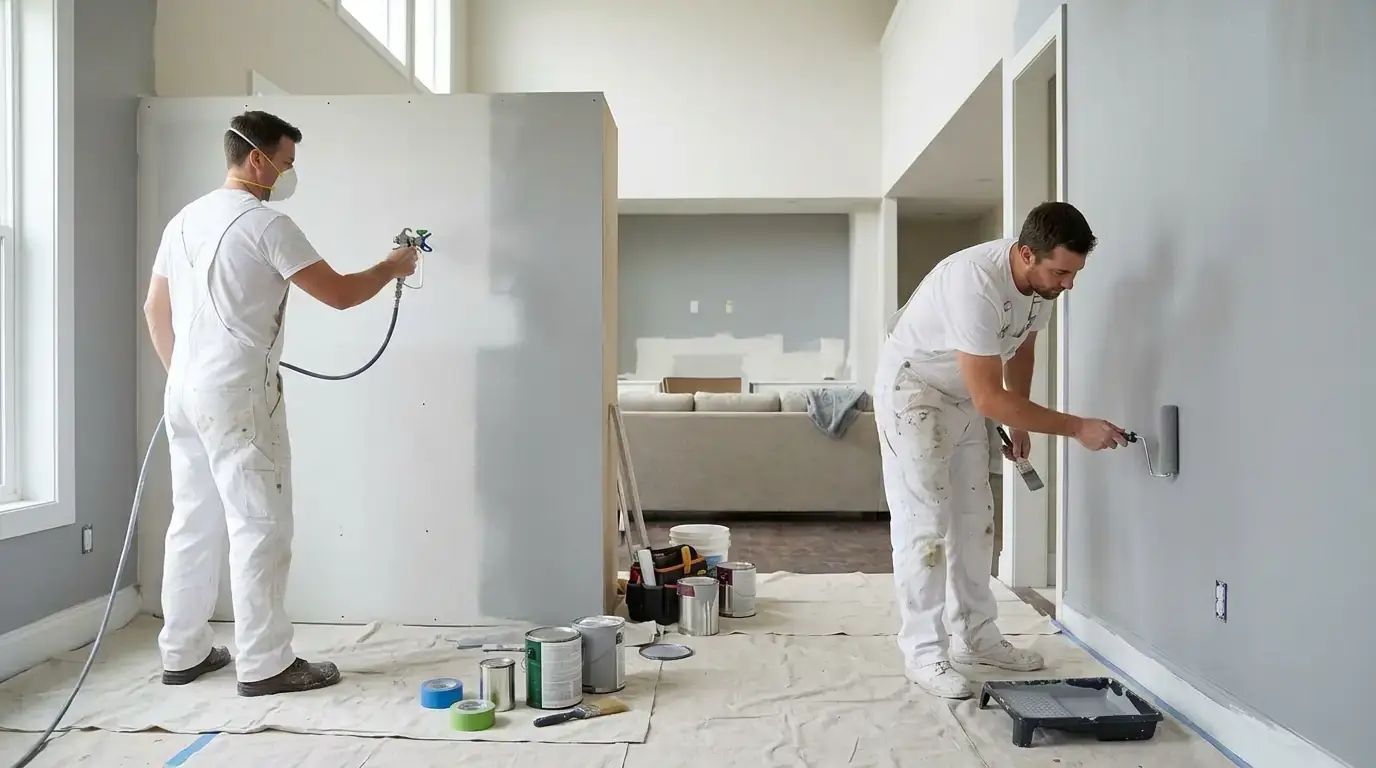
Spray, brush, and roller are not rival camps. Each solves a different application problem. In a real spray painting vs brush and roller comparison, spraying earns its place on open surfaces, repeatable components, and detailed profiles where a smoother film matters. Brush and roller regain the advantage in occupied rooms, around finished surfaces, and on smaller jobs where wrapping half the room in masking is more work than painting it. Professional painters choose the method that fits the work zone.
The practical decision involves more than raw application speed. Setup, masking, overspray control, surface texture, desired finish, access, and cleanup all factor in. Current Graco guidance treats airless spraying as a production method and identifies overspray protection as a planning requirement, not an optional step. Current Sherwin-Williams guidance still positions brushes for cutting in and rollers for broad walls and ceilings. Some projects combine spray with back-rolling. None of that points to a universal winner.
That is why the comparison should be made at project level, not by application speed alone. A method that puts coating on faster can still take longer overall if containment, masking, ventilation, touch-ups, and cleanup expand around it.
Let the Work Zone Choose the Method
Before choosing anything, look at the actual space. Is it empty or occupied? Are floors, windows, fixtures, cabinets, and furniture already finished? Is the surface broad and open or broken up by trim and obstacles? Is a smooth finish expected, or is a lightly textured result fine? Does the surface have grooves, profiles, spindles, or louvers? Can the work zone be effectively masked and isolated? Will overspray create risk for adjacent property, vehicles, or landscaping? Does the coating manufacturer allow spray, brush, roller, or a combination? Those answers usually make the method obvious.
| Project condition | Spray application often fits | Brush and roller often fit |
|---|---|---|
| Large empty interior | Strong option when masking can be done efficiently | Still suitable, especially if a rolled texture is desired |
| Occupied furnished room | Less attractive: protection and containment expand significantly | Usually easier to control around furniture and finished surfaces |
| Cabinet doors and detailed profiles | Strong option for a smooth, even finish | Useful for small repairs, edges, or a hand-finished appearance |
| Standard drywall walls | Can work well, sometimes with back-rolling depending on the system | Reliable and controllable with brush cut-in and roller application |
| Rough or highly textured surfaces | Can reach recesses quickly | Thicker-nap rollers can work coating into the texture |
| Small touch-up or one wall | Setup cost may outweigh the application benefit | Usually the practical choice |
Where Spray Earns Its Keep
Airless spray atomizes coating under pressure into a controlled fan. Because nothing physically drags across the wet film, spray can produce a very smooth appearance when the surface, coating, tip, pressure, distance, overlap, and technique are all dialled in. It’s especially useful for cabinet doors and drawer fronts, interior and exterior doors, trim packages before installation, spindles and railings, louvers and detailed profiles, large ceilings, new construction, empty commercial spaces, large exterior siding where overspray can be controlled, and industrial surfaces where production efficiency matters. Current Graco guidance specifically treats airless spraying as a production method for broad surfaces while noting that surrounding areas always need protection.
The Trigger Is Fast. The Masking Is the Bill.
Spray application moves fast once you pull the trigger. The time cost lives in what comes before. Masking and containment can include floors, windows, doors, hardware, lighting, cabinets, appliances, furniture, vents, adjacent rooms, exterior plants, and nearby vehicles. On a large empty space, masking can be efficient and the application-speed advantage is real. In a finished furnished room, brush and roller often completes the job faster when setup and cleanup are counted. The spray fan moving across a wall is the visible part. The twenty minutes sealing a doorway, wrapping a light fixture, and protecting a neighbour’s car is where the true comparison lives.
Brush and Roller Take Over When Control Matters
Brush and roller trade production speed for precision. Sherwin-Williams’ current guidance uses the familiar professional sequence: cut in edges, corners, and trim lines with an angled brush, then roll the broad wall while the edge is still wet. That combination gives exact control at boundaries and efficient coverage across the field. Brush and roller tend to be the better choice for occupied homes, single rooms, accent walls, touch-ups, small repaints, walls surrounded by finished trim and flooring, and projects where masking would cost more time than the painting itself.
On Most Wall Repaints, Brush and Roller Work as a Team
The phrase spray gun vs brush painting can mislead. On most conventional wall projects, the real comparison isn’t spray versus brush. It is spray versus a coordinated brush-and-roll system where the brush handles ceiling lines, inside corners, trim edges, and tight areas while the roller covers the broad field. Current Sherwin-Williams guidance recommends 2- to 3-inch angled brushes for cutting in and roller covers selected by surface texture.
When Spray Makes More Sense Than Rolling for Interior Walls
For large interior walls, the choice usually comes down to production conditions rather than finish quality alone. Spray can be attractive when the room is empty, finish work isn’t done yet, the same colour covers many connected surfaces, the area can be fully sealed off, and a crew is already mobilized for spray production. Rolling tends to be more practical when the room has furniture, trim and flooring are finished, only one or two walls are changing colour, or the project requires frequent colour changes. That’s the core airless spray painting vs roller tradeoff: spray reduces application time across open areas, while rolling reduces the containment and masking required around finished surfaces.
Back-Rolling Is a Technique, Not a Rule for Every Sprayed Surface
Back-rolling means applying coating by spray and then passing a roller over the wet film, combining fast material delivery with the texture and working action of a roller. Graco sells spray-and-roll systems for this workflow and identifies rough and porous surfaces as a good fit. But don’t assume every sprayed coating should be back-rolled. Sherwin-Williams offers at least one interior ceiling coating specifically designed for spray application without back-rolling. The coating, substrate, specification, and desired finish should determine whether back-rolling belongs in the plan, not habit.
Spraying Doesn’t Automatically Mean Better Adhesion
Some comparison pages claim spray application inherently creates stronger adhesion. That’s too broad. Adhesion depends on surface cleanliness, preparation quality, primer compatibility, coating selection, correct film thickness, application conditions, and proper drying and cure. A sprayed coating over grease or loose paint fails. A rolled coating over a properly prepared surface bonds well. The atomization method doesn’t replace preparation, and current manufacturer guidance doesn’t support claims that spray is inherently more durable than rolling.
The Finished Surface Should Determine the Method
Spray and roller can both produce professional results, but they don’t always look identical. Spray is useful when a smoother film with minimal roller texture is the goal, which is common on cabinet fronts, doors, trim components, and railings. Rollers leave a light texture determined by the cover and the coating; on drywall walls, that texture is normal and helps the surface look consistent with surrounding rolled areas. A skilled brush creates clean cut lines and smooth directional strokes on trim. Sherwin-Williams currently recommends longer finishing strokes when brushing trim to reduce visible brush marks. The right choice is the one that matches the surface and the expected appearance.
Spray Projects Are Most Efficient When Set Up for Spray From the Start
One of the real spray painting advantages Ontario properties can use is production efficiency, but only when spraying is planned from the start. An empty house before flooring arrives, a renovation with cabinets already removed, a batch of doors laid flat for finishing, a warehouse wall with open unobstructed sections: these environments reward spray setup time. Narrow urban side yards, parked vehicles, finished occupied interiors, and windy conditions all push the calculation the other way.
Airless Spray Has Hazards Rollers Don’t
Airless equipment operates at high pressure. Graco’s current safety guidance identifies injection injury, fire and explosion risk, and exposure to coating materials as hazards to plan for. Professional spray work should include controlled access to the work zone, proper masking and containment, appropriate ventilation, protective equipment suited to the coating and equipment, and protection of occupants, vehicles, landscaping, and neighbouring property. Brush and roller still require normal paint safety and ventilation, but they don’t carry the same high-pressure spray conditions. Property owners can review Graco’s airless sprayer safety guidance for equipment-specific context.
Does Spraying Cost Less Than Brush and Roller?
There’s no universal answer. Spray can reduce application labour on large open projects but adds time for masking, equipment setup, and cleanup. Brush and roller require more direct application time but usually need less containment. Total value depends on project size, how empty or finished the space is, surface complexity, access, finish expectations, and whether spray equipment is already mobilized. Ask the contractor which method is included in the quote and why it suits the scope. Faster application does not automatically mean a lower total project cost.
Common Mistakes When Choosing Application Method
- Choosing spray because it looks faster on video. Count masking and cleanup too.
- Avoiding spray because it seems messy. Proper containment can make spray the better method in the right space.
- Assuming spraying is always more durable. Preparation and coating system control adhesion, not the application method.
- Assuming every sprayed wall needs back-rolling. Check the coating and specification.
- Using spray in a space that can’t be properly isolated. Overspray control is part of the method, not optional.
- Using the wrong roller nap for the surface. Cover selection affects both coverage and texture.
- Treating the whole project as one application method. Professional projects routinely combine spray, brush, and roller across different surfaces.
Common Questions About Application Method
Is spraying always faster and better than rolling?
Not universally. Spray tends to be better for large open areas, detailed components, and smoother finishes. Brush and roller tend to be better for occupied interiors, smaller areas, and projects where precision matters more than production speed.
Does spraying always produce a smoother finish than rolling?
It can, when the surface, coating, equipment setup, and technique are all right. It isn’t guaranteed simply because a spray gun was used.
Should sprayed interior walls always be back-rolled?
No. Back-rolling suits some substrates and coating systems, but it isn’t a universal rule. Some coatings are designed to be sprayed without back-rolling. Follow the product and project specification.
Is brush and roller better for an occupied home?
Often, yes. Brush and roller usually require less extensive masking and create less overspray risk around furniture, flooring, and fixtures. The actual project layout should make the final call.
Why are cabinets usually sprayed instead of rolled?
Cabinet fronts and detailed profiles benefit from the smoother appearance spray can provide, and they can be removed or isolated more easily than a furnished room, which reduces the masking burden that makes spray less attractive in occupied spaces.
Can painters use spray and roller on the same job?
Yes, routinely. A project may spray ceilings or doors, brush detail areas, and roll walls, or spray and back-roll selected surfaces. Combining methods is normal when different surfaces have different finish and access requirements.
Pick the Workflow, Not a Winner
The practical answer to spray painting vs brush and roller is that each method solves a different production problem. Spray is strongest when surfaces are open, repeatable, detailed, or isolated for a smoother finish. Brush and roller are strongest when the painter needs precise control around finished surfaces, or when the project is too small to justify the setup. When the right method isn’t obvious from the scope, a site review should settle it.
For dedicated spray finishing information, see spray painting in Toronto.
To have a project reviewed and the right method confirmed for your specific space, Request a Free Quote through PaintersInToronto.ca. Quote requests are connected with one licensed and insured independent painting company, and any service agreement is directly with that contractor. Call (647) 532-9046 and Ask for SUNNY, or use the contact page.