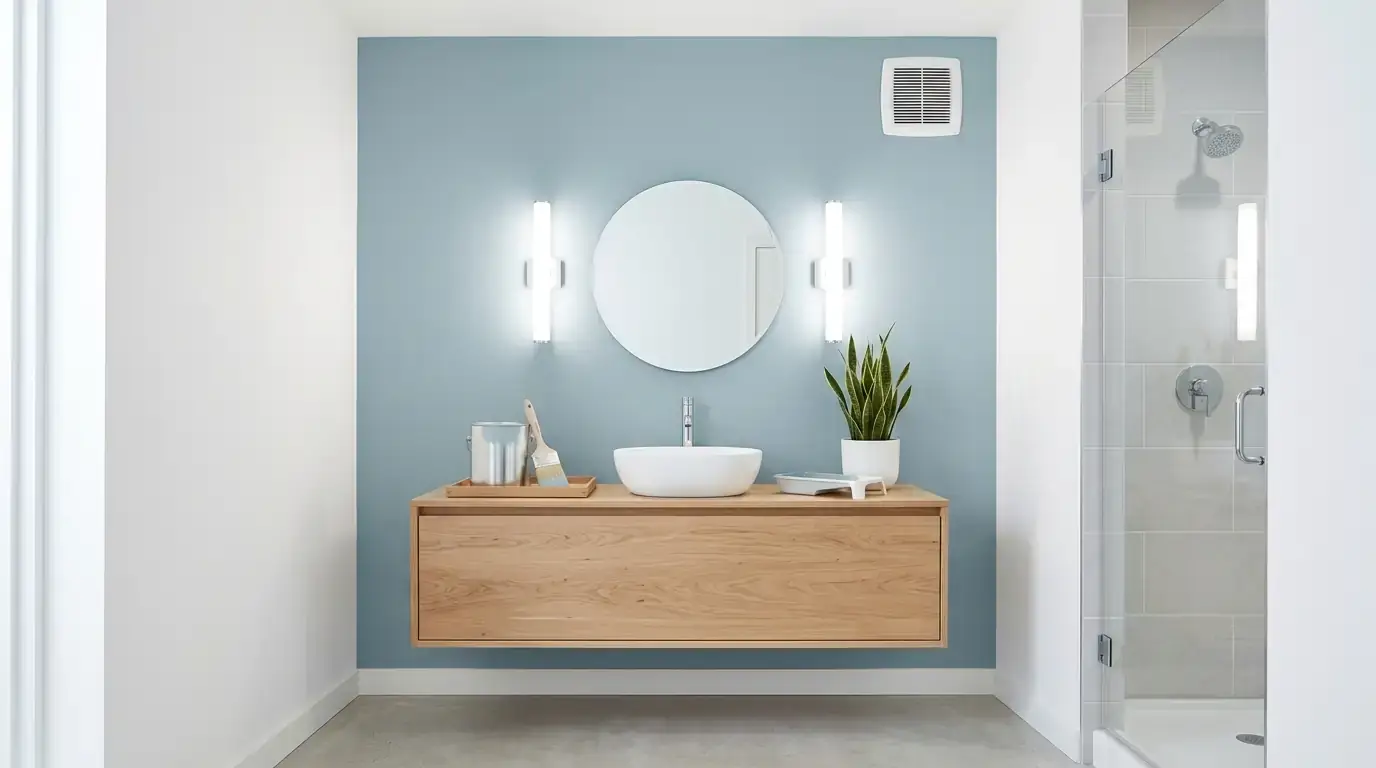
If your bathroom ceiling keeps peeling, repainting it for the third time is unlikely to make the room suddenly cooperative. The paint may be failing because the bathroom is staying wet for too long. That is the useful starting point for painting bathroom moisture ventilation Ontario homes: solve the moisture pattern first, then choose the coating.
Health Canada recommends using a bathroom exhaust fan during showers and baths, keeping it running for at least 30 minutes afterward, making sure it vents outdoors, and maintaining indoor relative humidity between about 30% and 50%. Those details matter more to long-term paint performance than simply reaching for the shiniest can on the shelf.
If the Same Spot Keeps Failing, the Room Is Telling You Something
Before choosing a colour, inspect the bathroom when it is dry and again after a normal shower. Look at the ceiling above the tub or shower, exterior walls, window edges, caulking, corners, and the area around the exhaust fan.
For a related next step, read What Paint Finish Should You Use, what paint finish for each room.
- Does condensation linger on the ceiling or mirror?
- Is paint bubbling, peeling, or soft in one repeated area?
- Are there water stains that return after repainting?
- Is the caulking cracked around the tub, shower, sink, or backsplash?
- Does the fan make noise without moving much air?
- Does the fan actually exhaust outdoors?
- Is drywall soft, swollen, or stained?
- Is visible mould returning after cleaning?
A bathroom coating can tolerate humidity better than an ordinary wall paint, but it cannot repair a plumbing leak, failed waterproofing, damp drywall, or a fan that dumps moist air into an attic. Paint is the finish layer, not the emergency services department.
The Exhaust Fan Is Part of the Paint Job, Even Though It Never Touches a Brush
Health Canada’s current moisture guidance says bathroom fans should have adequate air movement, vent outdoors rather than into an attic, run during bathing, and continue for at least 30 minutes afterward. It also recommends keeping indoor relative humidity between 30% and 50% to help control moisture and mould.
If the room is still fogged up long after a shower, the problem may be fan performance, a blocked duct, poor make-up air, a fan that is undersized for the real conditions, or simply a habit of switching it off too soon. The exact cause needs to be assessed before assuming another coat of paint will fix it.
Health Canada’s current guidance is available in its guide to addressing moisture and mould indoors.
Semi-Gloss Is Not the Only Bathroom Answer Anymore
For years, bathroom advice was reduced to one sentence: use semi-gloss. That is too simple now. Current Canadian manufacturers sell bathroom-specific coatings in lower sheens, including matte products designed for high-humidity rooms.
Benjamin Moore Canada currently lists Aura Bath & Spa as a coating for bathrooms and bathroom ceilings and identifies it as suitable for high-humidity environments with a mildew-resistant coating. The line includes matte finishes. That does not make matte automatically right for every bathroom, but it does prove that sheen alone does not determine moisture performance.
When choosing the best paint for bathroom Ontario conditions, look at the complete product rather than the sheen name:
- Is it intended for bathrooms or high-humidity spaces?
- How washable does the room need to be?
- How smooth is the wall? Higher sheen can advertise every patch and roller ridge.
- Will the surface receive splashes, or only humid air?
- What does the manufacturer say about drying, recoating, cleaning, and return to service?
Matte and lower-sheen bathroom paint
A bathroom-rated matte can work where the product is specifically designed for humid conditions and the room’s cleaning demands fit the coating. It can also be kinder to walls with minor surface imperfections because it reflects less light.
Eggshell and satin
These finishes are common compromises for walls that need regular wiping without a strong shine. The formulation still matters. A bathroom-rated satin and a generic interior satin are not automatically equivalent.
Semi-gloss
Semi-gloss remains useful on doors, trim, and surfaces that receive frequent wiping. It can also work on walls, but its reflectivity makes poor drywall repairs much easier to see. A glossy finish does not compensate for poor moisture control.
The Ceiling Usually Gets the Worst Seat in the House
Steam rises, and bathroom ceilings often collect the consequences. Look closely above the shower, near exterior corners, and around the fan grille. Repeated spotting or peeling may point to condensation, poor ventilation, old coating failure, or a previous moisture problem.
Current Canadian ceiling products are available with mildew-resistant coatings, and bathroom-specific wall products may also be approved for ceilings. The right choice depends on the existing surface and the product instructions. If the ceiling is already peeling, prep and moisture diagnosis matter before product selection.
Primer Is a Problem-Solver, Not a Bathroom Membership Fee
A bathroom does not automatically need full-wall primer simply because it contains a shower. Primer earns its place when the substrate or problem calls for it.
Primer may be useful for:
- new or repaired drywall
- bare plaster
- patched areas with uneven porosity
- stains after the moisture source has been corrected
- bare wood or repaired trim
- slick or adhesion-sensitive existing finishes
- significant colour changes when the selected coating system calls for it
Current Canadian primers are available with mildew-resistant dried films, but that feature should not be mistaken for mould remediation. If the substrate is wet, contaminated, soft, or failing, primer is not the cure.
Visible Mould Changes the Order of Work
Do not make visible mould disappear under paint and call the project complete. Health Canada says recurring mould will return unless the underlying moisture source is identified and solved.
For small areas, Health Canada currently recommends cleaning visible mould with water and unscented dishwashing detergent. Larger, recurring, or heavily damaged areas can require professional assessment, and porous materials that cannot be properly cleaned may need replacement.
The sensible order is to correct the moisture source, dry the area, clean or remove affected material as appropriate, repair the surface, prime where the repaired substrate needs it, and only then apply the finish coating.
Condensation and Leaks Can Look Similar From the Paint Side
A recurring ceiling stain does not tell you by itself whether the problem is shower humidity, a plumbing leak, roof or flashing trouble above the room, or condensation on a cold surface. The pattern and timing help.
If staining appears after showers and the room remains visibly damp, ventilation deserves attention. If a stain grows even when the bathroom has not been used, or if drywall becomes soft, a leak may be more likely. Water around a tub edge or shower enclosure can also travel behind finishes before showing up somewhere else.
Do not use paint as the diagnostic test. If the cause is unclear, investigate the moisture path before repairing the finish. A stain-blocking primer can stop an old, dry stain from bleeding through a new coat, but it should be used only after the source is corrected and the substrate is dry enough for the system.
Sometimes You Need a Local Repair, Not a Full Bathroom Repaint
If most of the room is sound and one small area failed because of a corrected leak or a localized repair, the project may not require repainting every wall. The challenge is appearance. A spot repair can flash if the new paint, sheen, texture, or roller application does not match the surrounding aged finish.
On a large visible wall or ceiling, repainting the repaired plane from corner to corner can produce a more consistent result than repeatedly touching the same patch. In a tiny hidden area, a careful local repair may be enough. Judge the scope after the repair is primed and viewed under normal bathroom lighting.
Prep a Bathroom Like a Bathroom, Not Like an Empty Bedroom
Bathroom walls collect more than dust. Hairspray, soap film, cosmetics, fingerprints, condensation residue, and cleaning products can all interfere with adhesion.
A careful prep pass usually includes removing accessories where practical, cleaning contaminated surfaces without leaving residue, scraping loose paint, repairing drywall or plaster, replacing failed paintable caulk where appropriate, sanding repairs smooth, and priming only where the surface calls for it.
Wet joints around tubs and showers deserve special care. The sealant used there may be part of the water-control system and may not be paintable. Do not casually replace bathroom sealant with ordinary painter’s caulk just because a paintbrush is nearby.
Paint Does Not Turn Drywall Into a Shower Pan
A moisture-resistant coating is still paint. It is not a waterproofing membrane for areas receiving direct, repeated water exposure. Shower interiors, tub surrounds, tile assemblies, plumbing penetrations, and concealed wet-area systems need to perform as their own assemblies.
If water is getting behind tile, through failed grout or sealant, or into a wall cavity, painting bathroom walls Ontario homes will not solve the leak. Fix the water path before beautifying the evidence.
Dry, Recoat, and Ready for Abuse Are Three Different Moments
Fresh paint can feel dry well before it has developed its full service properties. That distinction matters in bathrooms because the room may soon face steam, wiping, splashes, and cleaning.
Manufacturer data can list separate dry-to-touch, recoat, and return-to-service milestones. Use the exact product instructions rather than borrowing a time from another brand or assuming the room can take normal humidity because the wall no longer feels tacky.
During the early cure period, be gentle with freshly painted surfaces and keep ventilation working. Do not scrub the wall, press accessories against it, or expose it to unnecessary moisture before the selected coating is ready.
After the First Few Showers, Inspect the Room Again
The best post-paint inspection happens after the bathroom returns to normal use. Watch what the room does after several showers.
- Does heavy condensation linger?
- Is the ceiling drying evenly?
- Is the fan grille clear and working?
- Are old stains bleeding back through?
- Are repaired areas staying flat and dry?
- Are wet-area caulk joints intact?
- Is any familiar mould spotting returning?
If the same moisture symptom starts coming back, do not add another coat. Revisit the fan, humidity, leak, caulking, or cold-surface condensation that is feeding the problem.
Bathroom Painting Questions Worth Answering Before You Buy Paint
Can I use matte paint in a steamy bathroom?
Yes, if the exact matte product is designed for bathrooms or high-humidity interiors and its cleaning performance suits the room. Current Canadian bathroom-specific matte coatings exist, so semi-gloss is no longer the only workable option.
Why does my bathroom ceiling keep peeling after repainting?
Recurring peeling can come from lingering condensation, poor ventilation, a leak, damp substrate, weak old paint, or inadequate preparation. Repainting without identifying the cause often gives the same problem a fresh colour.
Should the exhaust fan stay on after I leave the shower?
Yes. Health Canada recommends keeping the bathroom exhaust fan running for at least 30 minutes after a shower or bath and making sure it vents outdoors.
Can mould-resistant primer be painted over visible mould?
Primer should not be used as the first response to active mould. Correct the moisture source and clean or remove affected material appropriately before the coating system begins.
What indoor humidity should I aim for?
Health Canada recommends maintaining indoor relative humidity between about 30% and 50% to help control moisture and mould.
Do all bathroom walls need primer?
No. Primer depends on the substrate and condition. Bare repairs, stains, new drywall, plaster, bare wood, or adhesion concerns may need it, while a sound compatible painted wall may not require full priming.
Make the Bathroom Dry Better Before Asking the Paint to Work Harder
The strongest painting bathroom moisture ventilation Ontario plan is not complicated: make sure the room can get rid of moisture, fix leaks and failed wet-area joints, repair the substrate, then select a bathroom-suitable coating and give it the time the manufacturer requires.
For broader preparation and coating planning, see interior painting in Toronto.
If the bathroom keeps peeling, staining, or spotting and you want the surface condition reviewed as part of a repaint, you can request a quote through PaintersInToronto.ca. PaintersInToronto.ca works exclusively with one licensed and insured independent painting company, and any service agreement is directly with that contractor. Call (647) 532-9046 and Ask for SUNNY.