A square foot is a wonderfully precise unit until two painting quotes use it to mean two different things. With commercial painting cost per square foot Ontario estimates, one contractor may be pricing from the suite’s floor area while another is pricing the actual wall area. A $3 rate and a $5 rate can therefore describe completely different scopes.
For early 2026 budgeting, current Toronto commercial guides put many ordinary interior projects in a broad floor-area ballpark of roughly $2 to $6 CAD per square foot. Offices often sit inside that band, while retail detail, difficult access, heavier preparation, specialty coatings, or restricted work windows can move the number. Treat that range as a budgeting shortcut, not a price promise.
The actual price may be lower or higher after the property, surfaces, preparation, access, materials, timing, size, and scope are reviewed.
For a related next step, read Exterior Painting Cost in Toronto, exterior painting cost Toronto.
Before You Compare Rates, Ask What the Square Foot Measures
There are two common ways a commercial painting estimate can use square footage:
- Floor-area pricing: The contractor uses the building or suite floor area as a simple estimating basis. A 5,000 square foot office might be discussed as a 5,000 square foot painting project even though the actual paintable wall area is different.
- Paintable-surface pricing: The contractor measures the walls, ceilings, steel, concrete, or other surfaces that will actually receive coating. This can produce a very different square-foot rate.
Current Toronto sources use both approaches. Home Painters Pro publishes commercial pricing based on floor area. RenoHouse publishes several 2026 commercial rates on a paintable-wall-surface basis. Those numbers should not be placed side by side without explaining the measurement.
When reviewing a proposal, ask one direct question: Is this rate based on floor area or actual paintable surface?
What Current 2026 Toronto Commercial Ranges Suggest
The ranges below combine current Toronto and Ontario contractor pricing into a practical budgeting view. They are not a contractor quote and they do not all represent the same scope.
| Commercial space | Current market ballpark | Measurement note |
|---|---|---|
| Standard office interior | About $2.50 to $5 per sq ft | Commonly published on a floor-area basis |
| Retail interior | About $3.50 to $7 per sq ft | Floor-area guides often run higher because of fixtures, durability, detail, and access |
| Warehouse or basic industrial interior | About $1.50 to $3.50 per sq ft | Large open areas may price lower, but height and specialty coatings can raise the rate |
| Detailed or specialty commercial spaces | Often above standard office ranges | Medical, food-service, high-performance, epoxy, or controlled-access scopes can require separate pricing |
Home Painters Pro currently publishes a broad Toronto commercial range of roughly $2 to $6 per square foot based on floor area, with office, retail, restaurant, warehouse, medical, and other space types separated within that range. GTA Paint’s current commercial guides show similar overlap but with wider property-specific bands, including higher ranges for retail and more complex work. Enviro Painting also publishes Ontario commercial project examples and exterior square-foot ranges that vary with preparation, access, coating type, and project complexity.
Because these sources define scope differently, the useful conclusion is not that one number is the “correct” Ontario rate. The useful conclusion is that square-foot pricing is only meaningful after the measurement basis and work scope are defined.
The Rate Means Very Little Until the Inclusions Are Written Down
A complete commercial quote should describe the actual work instead of relying on one rate. Depending on the project, the scope may include:
- site protection and floor covering
- moving or protecting furniture and equipment
- cleaning walls and other surfaces
- minor patching and sanding
- spot priming repaired or stained areas
- one or more finish coats
- paint and standard materials
- doors, frames, baseboards, trim, or ceilings if specifically listed
- daily cleanup and final cleanup
- phased work around occupied areas
- lift or scaffold access when required
Do not assume all of these are included just because a proposal gives a per-square-foot number. One contractor may be quoting walls only with light preparation. Another may include ceilings, doors, frames, repairs, premium coatings, lift rental, and off-hours work.
The Work That Often Escapes a Simple Wall-Painting Rate
Commercial projects often contain work that does not fit cleanly into a standard wall-painting rate. Ask whether the following are included or separate:
- major drywall or plaster repair
- water-damage repair after the cause is corrected
- extensive scraping or coating removal
- rust treatment and metal primers
- epoxy or other resinous floor coatings
- line marking
- high-bay ceilings
- structural steel
- specialty coatings
- parking garages
- exterior access equipment
- night, weekend, or restricted-access scheduling
- complex masking around machinery, racking, inventory, or sensitive areas
These items can change the economics of a project enough that a simple office-wall rate no longer describes the job accurately.
Two Identical Offices Can Have Very Different Prep Bills
Two offices with the same floor area can produce very different bids if the walls are in different condition.
A relatively clean office repaint may require minor patching, sanding, spot priming, and two finish coats. Another office of the same size might have removed wall systems, dozens of anchors, failed caulking, heavy scuffs, damaged corners, stains, old repairs, or colour changes that require more preparation.
Preparation is labour. The more hours needed before coating begins, the less useful a simple square-foot comparison becomes.
When asking how much does commercial painting cost, describe the condition as carefully as you describe the size.
Height Turns Lifts, Setup and Access Into Cost Items
Commercial spaces are often priced differently when walls extend above ordinary ladder height or when the work requires lifts, scaffolding, special access, or repeated equipment moves.
Access can be a major difference between:
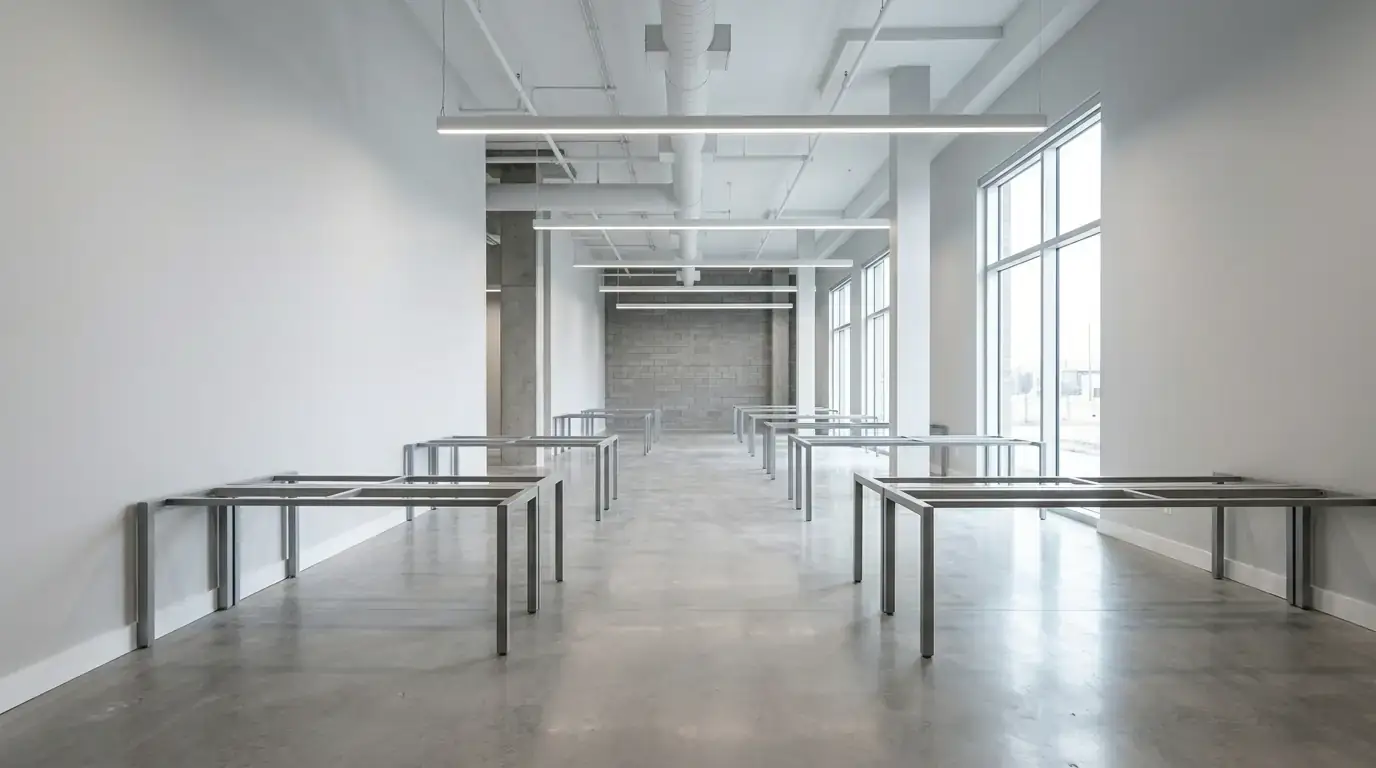
- a vacant office with standard-height drywall walls
- a retail store with tall feature walls and fixtures
- a warehouse with high masonry walls
- a stairwell spanning multiple floors
- a lobby with open ceilings or architectural details
The contractor may need to price equipment, operator time, floor protection, setup, and lost production time from repeatedly moving access equipment.
An Empty Suite and a Working Office Are Not the Same Painting Job
A vacant suite is usually easier to stage for painting than an occupied business. In an active office, retail store, clinic, or facility, the painter may need to:
- move and reset furniture in phases
- protect computers and equipment
- maintain customer or employee routes
- work around meetings or operating hours
- complete areas in smaller sections
- perform more daily setup and cleanup
- coordinate security, elevators, loading, and building access
That extra coordination is one reason two projects with the same floor area can have different square-foot rates.
Restricted Work Hours Can Cost More Without Having One Standard Premium
Current Toronto commercial painting pages commonly advertise evening, overnight, weekend, and phased scheduling. Some also publish additional charges or higher price bands for restricted access windows.
Do not assume a universal after-hours premium. The impact depends on the contractor, crew arrangement, building rules, parking, security, elevators, noise restrictions, work zone size, and how many shifts are needed.
The correct budgeting question is: Does this quote assume normal weekday access, or does it include the actual hours our building allows?
Larger Projects Can Spread the Fixed Costs More Efficiently
Small commercial jobs often have a higher effective square-foot cost because mobilization does not disappear. A contractor still needs to visit the site, bring tools and materials, protect the area, perform setup, complete cleanup, and manage the project.
Current Toronto contractor guides commonly show lower effective square-foot bands as project size increases. Larger projects can spread setup and management costs across more area, although that advantage can disappear if the larger facility also has difficult access, heavy preparation, many colours, or operational constraints.
This is why multiplying a small-office price by ten is not always a reliable way to budget a much larger facility.
Commercial Scope Has Costs a Bedroom Repaint Never Sees
Commercial work can involve considerations that a straightforward residential room repaint may not have:
- tenant and landlord coordination
- building-management requirements
- large crews or staged crews
- security access
- occupied work zones
- high-reach equipment
- industrial substrates
- specialty coating systems
- strict completion windows
- multiple departments or stakeholders approving the work
That does not mean every commercial job is automatically more expensive per square foot. Large, open, empty spaces can sometimes be efficient to paint. It means the pricing method needs to reflect the real operating and surface conditions.
Normalize the Scope Before You Decide Which Quote Is Cheaper
Instead of choosing the proposal with the lowest square-foot number, normalize the scope.
- Measurement basis: floor area or actual paintable surface?
- Included surfaces: walls only, or ceilings, doors, frames, trim, steel, and other surfaces?
- Preparation: what level of cleaning, patching, sanding, repair, and priming is included?
- Coating system: how many coats, and what type of coating?
- Materials: are paint and consumables included?
- Access assumptions: standard hours, evenings, weekends, lifts, scaffolds, loading, parking, and security?
- Protection and cleanup: what happens to furniture, equipment, floors, inventory, and waste?
- Exclusions: are large repairs, specialty coatings, floor work, exterior work, and change orders clearly separated?
Once those items match, the price comparison becomes much more useful.
What a 5,000 Square Foot Office Budget Might Look Like
Suppose a property manager has a 5,000 square foot office. Using a current floor-area planning band around $3 to $5 per square foot produces a rough early budget of about $15,000 to $25,000. That is useful for a capital-planning spreadsheet. It is not enough information to award the work.
The actual project could be lower or higher depending on wall quantity, ceiling height, number of offices, colours, trim, repairs, occupied conditions, materials, access hours, and whether ceilings or other surfaces are included.
The example is useful only as an early budgeting tool before a site review.
Common Reasons Commercial Painting Budgets Overrun
- Comparing floor-area pricing with wall-surface pricing. The rates are not directly comparable.
- Assuming the cheapest rate includes the same scope. Check coats, paint, repairs, ceilings, trim, and access.
- Ignoring preparation. Damaged surfaces can add substantial labour.
- Using office pricing for warehouses or specialty facilities. Different substrates and access conditions can change the system.
- Forgetting restricted hours. Confirm whether the estimate assumes normal daytime access.
- Treating internet ranges as contractor commitments. Published figures are planning guidance, not site-specific quotes.
Commercial Painting Cost Questions Answered
What is the commercial painting cost per square foot in Ontario?
Current 2026 Toronto and Ontario contractor sources most commonly publish broad standard-commercial ranges around $2 to $6 per square foot based on floor area, with retail, high-prep, and specialty scopes running higher. Always confirm whether a quote uses floor area or actual paintable wall area before comparing it to another, and verify exactly what surfaces and preparation are included.
Is commercial painting priced by floor square footage or wall square footage?
Both methods are used, and they produce very different numbers for the same space. Some contractors use floor area for estimating convenience; others measure actual paintable wall or ceiling surface. Ask this question directly before placing any two proposals side by side. Comparing a floor-area rate with a wall-surface rate gives you a meaningless comparison.
What does commercial painting usually include?
It depends on the contractor and the project. That is precisely why comparing written scopes matters more than comparing headline rates. A quote may include site protection, surface cleaning, minor patching, spot priming, one or more finish coats, materials, and cleanup. Ceilings, trim, doors, substantial repairs, lift rental, specialty coatings, and after-hours scheduling are commonly priced as separate line items.
Why does a small office sometimes cost more per square foot?
Because mobilization does not disappear with room size. Travel, tool delivery, site protection, daily setup, cleanup, supervision, and project management all occur whether the project covers 200 square feet or 20,000. On a small job, those fixed costs are spread over far fewer square feet. That is why a single accent wall or a small meeting room can look expensive when judged by rate alone.
Does after-hours commercial painting cost more?
Sometimes, but there is no standard premium. The cost impact depends on the contractor’s crew arrangement, building access hours, security requirements, parking availability, shift length, number of phases needed, and any overtime or inconvenience allowance baked into the proposal. The right question is whether the quote was built assuming your actual access hours or standard daytime access.
How accurate is an online commercial painting cost calculator?
It is useful for rough early budgeting, and not much more. Online calculators cannot assess surface condition, preparation complexity, ceiling height, access restrictions, coating system requirements, or occupancy constraints. Use a calculator to build an initial budget range, then have the actual space reviewed before committing to a scope or approving a proposal.
The Denominator Matters More Than the Headline Rate
The most useful way to read a commercial painting cost per square foot Ontario guide is as a starting framework, not a price list. Confirm the measurement basis first. Then normalize every proposal by preparation level, included surfaces, coating system, access hours, and clearly stated exclusions. The budget number makes sense only after those variables match.
For broader Ontario and Toronto pricing information, see the painting cost guide.
Once you have the floor area, included surfaces, prep level, coating system, access hours, and exclusions, you have enough information to ask for a meaningful project quote. PaintersInToronto.ca sends commercial quote requests to one licensed and insured independent painting company. The contractor, rather than the website, is the party to any service agreement. Call (647) 532-9046 and Ask for SUNNY if you prefer to discuss the scope by phone.